Mention blockchain to most people, and cryptocurrency is the first thing that comes to mind.
Furthermore, that association makes sense historically, but it genuinely undersells what this technology actually offers e-commerce businesses today. Blockchain’s real influence on online commerce extends well beyond crypto payments — it tackles technological, legal, organizational, and consumer trust issues that traditional systems have struggled with for years.
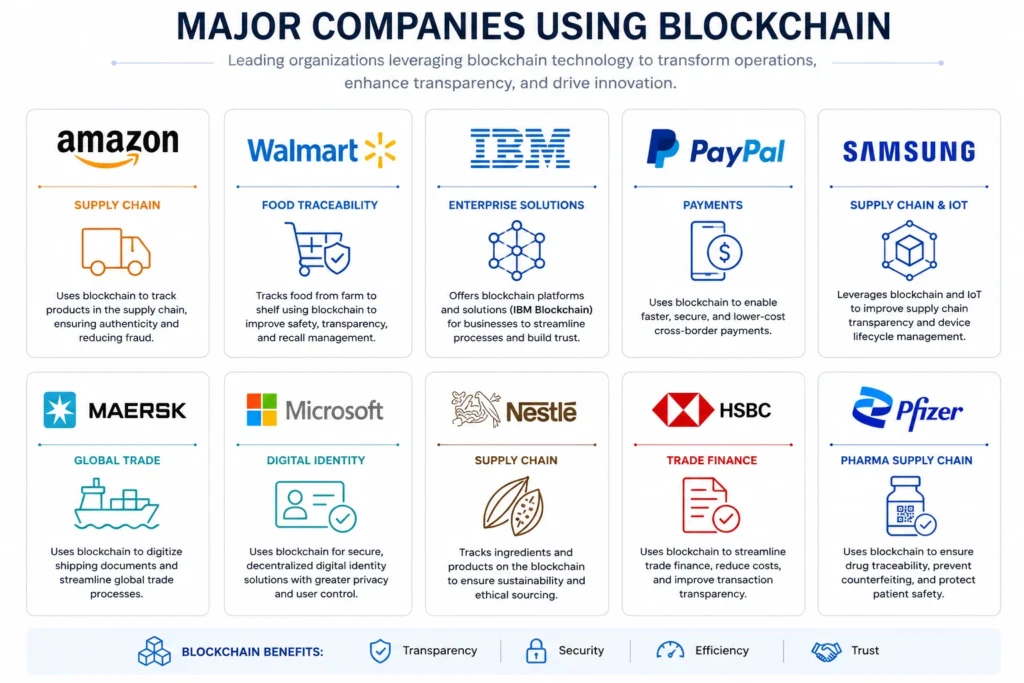
Consequently, more than 81% of the world’s top 100 companies now have live blockchain operations, including household names like Amazon, Walmart, IBM, PayPal, and Samsung. Furthermore, the global blockchain supply chain industry alone is projected to grow from $253 million to over $3.2 billion within a few years — a trajectory that reflects genuine operational value, not passing hype.
In this guide, we explore exactly how blockchain works, why it matters for e-commerce specifically, and the five practical use cases — beyond simply accepting crypto — that are already reshaping how online businesses build trust with customers and partners. Furthermore, we cover when blockchain genuinely solves a real problem and when it is simply unnecessary complexity.
What is Blockchain?
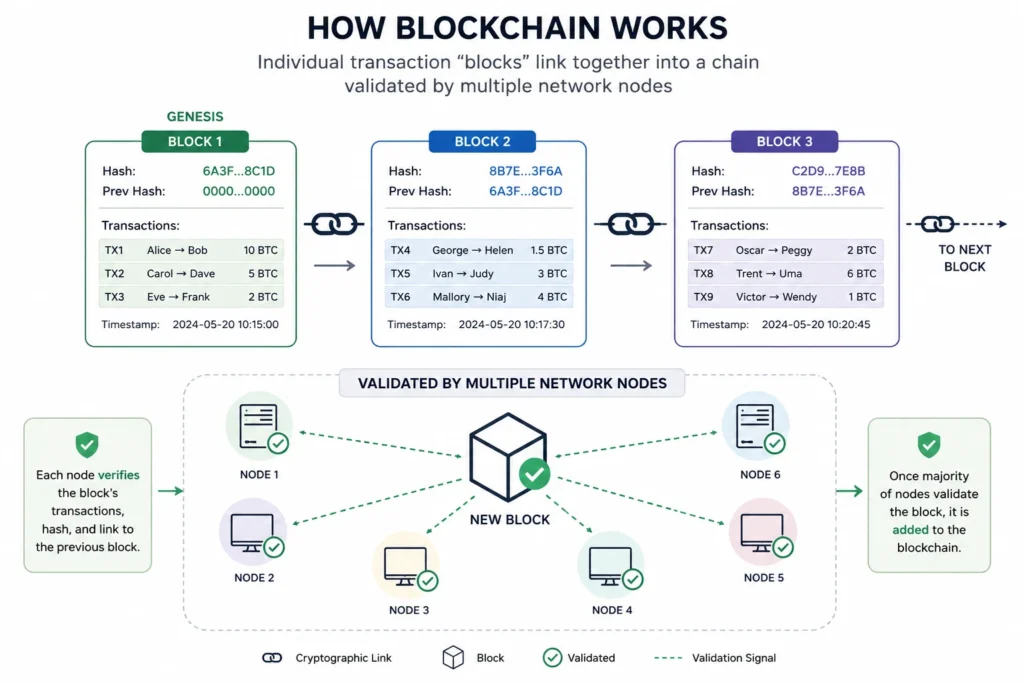
Blockchain gets its name directly from its structure. Furthermore, individual records of activity, called blocks, link together in a sequential list called a chain. This chain gets validated and maintained by a distributed network of computers — called nodes, peers, or miners — whose job is to verify and transmit transaction data, eliminating the need for a central regulator or intermediary.
Furthermore, this concept is easiest to understand through a money transfer example. When a transaction occurs, the network of nodes verifies it, prevents the same funds from being spent twice, and keeps the original input data intact and unchangeable — since every node monitors the same record simultaneously. Consequently, altering historical data becomes practically impossible without the entire network noticing.
Three Types of Blockchain, and Why the Difference Matters
Blockchain networks generally fall into three categories, and understanding this distinction genuinely matters for e-commerce applications.
Permissionless (public) blockchains allow anyone to join the network pseudo-anonymously and become a node without restricting other participants’ rights. Furthermore, these networks power most cryptocurrency payment systems.
Permissioned blockchains restrict who can join as a node and what rights they hold. Furthermore, this category splits further into private blockchains, controlled by a single organization, and consortium blockchains, governed collectively by a group of organizations — both commonly used for B2B exchange networks and supply chain collaboration.
Hybrid blockchains combine properties of both — an entity maintains control while still pairing with public blockchain elements to ensure transparency for specific transaction validations.
Consequently, e-commerce businesses often combine these models strategically — using private, consortium, or hybrid blockchains for supply chain and B2B processes, while adding public blockchains specifically to expand payment options.
Why 81% of Top Companies Already Use Blockchain
Cost and Time Efficiency
Blockchain payments eliminate intermediaries like banks that traditionally handle verification and fraud detection separately. Furthermore, this enables genuinely fast, direct transactions — confirmed and finalized by the network within seconds rather than the days traditional cross-border payments sometimes require.
Moreover, for inventory management specifically, hybrid and consortium blockchains help leverage stock, inventory, and logistics costs while preventing price fluctuation caused by misinformation or deliberate attempts to alter pricing or supply terms. Consequently, businesses reduce both transaction friction and the third-party integration costs typically required for payment processing and inventory coordination.
Privacy and Security
Furthermore, because every blockchain transaction gets monitored and verified by trusted network entities rather than a single central authority, blockchain adds a meaningful additional layer of protection against fraud and cyberattacks. Consequently, businesses handling sensitive transaction data gain genuine security benefits beyond what traditional centralized databases typically offer.
Data Traceability
Furthermore, e-commerce transactions occurring through supply chains involve enormous amounts of interdependent data that must remain accurate and unaltered. Consider a store selling 15 beauty kits at $90 each, where a data error changes the quantity to 1,500 — with a thousand customers already having ordered based on incorrect availability. Resolving that error traditionally means apologizing to customers, processing refunds, and potentially damaging trust for days.
Moreover, blockchain prevents these exact situations by storing purchase-related data in an ordered, immutable format that remains intact throughout the entire supply chain. Consequently, the kind of costly operational errors caused by altered or inconsistent data become significantly less likely.
Decentralized Cloud Storage
Furthermore, blockchain pairs naturally with cloud storage by breaking information into pieces and transmitting it across a distributed network rather than storing it in one vulnerable central location. Moreover, this decentralized approach creates genuine protection against cyberattacks while enabling faster, more complete data recovery — particularly valuable for businesses handling sensitive customer information.
5 Practical Blockchain Use Cases Beyond Crypto Payments
Use Case 1: Smart Contracts
Smart contracts use blockchain-based digital signatures to verify that content is original and the sender is genuinely who they claim to be. Furthermore, this verification relies on mathematical techniques involving public and private keys — a private key signs any document the user wants to send, while the corresponding public key authenticates and confirms the integrity of that transaction, remaining visible and trackable throughout.
In e-commerce specifically, contract verification and authentication eliminate the need for in-person meetings entirely, which matters enormously for cross-border B2B relationships. Furthermore, smart contracts help businesses exchange money, property, shares, or anything of predetermined value once specific terms and conditions are genuinely met — without bureaucratic delay.
Moreover, real businesses already use this capability at scale. The Home Depot uses IBM’s smart contract infrastructure, and numerous American and European banks leverage smart contracts specifically to expand their client and partner networks faster than traditional contract processes would allow.
Use Case 2: Supply Chain Transparency
Furthermore, because blockchain data remains immutable once recorded, companies can genuinely monitor their suppliers’ quality compliance with confidence. This capability particularly benefits industries where quality forms a core part of the brand’s actual value proposition.
Consider an online food store selling exclusively organic products. Furthermore, if that store sources from overseas suppliers, verifying organic certification in person becomes genuinely difficult. Blockchain allows retailers to track product origin reliably, then use that verified data to strengthen brand credibility, operational efficiency, and safety messaging that resonates with increasingly skeptical consumers.
Use Case 3: Loyalty Programs
Furthermore, reward programs have become a genuine customer expectation — with a majority of consumers willing to switch brands specifically for a better, more straightforward loyalty program. However, most customers do not simply want to spend rewards on themselves; many would actually rather donate points to a cause they care about if given that flexibility.
Blockchain addresses several loyalty program pain points simultaneously — enabling straightforward point transfers, smart contracts that simplify collection and redemption, and tokens that create genuine partnership networks offering unique cross-brand promotions. Moreover, real companies including Singapore Airlines and various financial institutions already use blockchain specifically to make loyalty programs faster and more flexible for their customers.
Use Case 4: Cryptocurrency Payments
Furthermore, tens of thousands of venues worldwide now accept cryptocurrency as a payment method, and that number continues growing steadily. Blockchain-based payments make sending and collecting money more convenient than traditional card processing that routes through banks, while also proving more secure — since blockchain performs verification by definition rather than requiring separate fraud-checking systems.
Consequently, for e-commerce businesses specifically, this combination of speed and security addresses two of the most persistent friction points in online payment processing simultaneously.
Use Case 5: Genuine, Verifiable Reviews
Furthermore, a company’s market success depends heavily on customer feedback, yet ratings and reviews sections are not always trustworthy — fake reviews from people who never actually purchased the product remain a persistent problem across e-commerce.
Blockchain addresses this directly by authenticating genuine purchasers and publishing reviews specifically from verified customers, preventing outside parties from writing reviews as if they had purchased when they had not. Consequently, this restores genuine decision-making power to customers who rely on reviews before making purchase decisions.
How to Decide If Blockchain Makes Sense for Your Business
When Blockchain Genuinely Applies
Furthermore, blockchain makes sense specifically when you need stronger trust, traceability, and verification across multiple parties — particularly in supply chains, B2B collaboration, loyalty ecosystems, and review authenticity. Consequently, it becomes most relevant when you are coordinating data and transactions between separate organizations and want to reduce manual reconciliation, disputes, and fraud risk.
When You Should Skip It
Furthermore, blockchain is not the right tool if you do not have a genuine multi-party trust problem to solve, if a standard database with proper access controls already covers your needs, or if you cannot justify the added implementation complexity. Consequently, if your only goal is simply “accept crypto payments,” broader blockchain adoption across your entire operation is likely unnecessary.
A Practical Implementation Checklist
Furthermore, if blockchain genuinely fits your business needs, work through these steps methodically:
✅ Define the specific problem you are solving — traceability, fraud reduction, B2B coordination, or review verification
✅ Identify every party involved — suppliers, logistics partners, internal teams, customers
✅ Choose the blockchain type that fits — permissionless, permissioned, or hybrid
✅ Define what data must be immutable and shared versus what should stay private
✅ Map your current workflow end-to-end and mark exactly where verification currently breaks down
✅ Define clear success metrics — time-to-verify, dispute rate, fraud rate, engagement
✅ Build a limited-scope proof of concept using real data flows before full rollout
✅ Address compliance and data protection requirements from the start
The Future of Blockchain in E-Commerce
The future of blockchain in e-commerce looks highly promising as the technology continues to evolve and find new applications beyond digital payments. In the coming years, blockchain is expected to drive greater trust and transparency across online marketplaces, ensuring that every product’s journey from manufacturer to customer is traceable and verifiable. This will not only help businesses combat counterfeiting but also give consumers more confidence in the authenticity and ethical sourcing of the products they buy. As global e-commerce expands, blockchain will become a vital tool for building stronger customer relationships and brand loyalty.
Another major role blockchain will play in the future of e-commerce is in data security and digital identity management. With cyber threats becoming more advanced, businesses will increasingly rely on decentralized blockchain systems to safeguard sensitive customer information. Blockchain-based digital IDs could replace traditional login systems, allowing users to shop online without exposing personal data to hackers. At the same time, smart contracts will revolutionize business processes by automating payments, returns, warranties, and loyalty programs, creating faster and more efficient customer experiences.
Trust & Transparency: Verifiable product journeys and reduced counterfeiting.
Data Security: Decentralized systems protect customer information.
Digital Identity: Blockchain-based IDs for safer online shopping.
Smart Contracts: Automation of payments, refunds, warranties, and rewards.
Decentralized Marketplaces: Direct buyer-seller connections with lower costs.
Customer Trust: Tamper-proof reviews and ethical sourcing verification.
Competitive Advantage: Early adoption gives businesses a strong edge.
Conclusion
Blockchain deserves recognition for far more than enabling cryptocurrency payments. Furthermore, its ability to create verifiable, tamper-resistant records addresses genuine, persistent problems that e-commerce businesses have struggled with for years — supply chain data integrity, contract verification without bureaucracy, loyalty program flexibility, and review authenticity.
Moreover, the businesses already benefiting from blockchain — Amazon, Walmart, IBM, The Home Depot, Singapore Airlines, and dozens of others — did not adopt this technology because it was trendy. They adopted it because it solved specific, costly operational problems that traditional systems handled poorly.
Therefore, before dismissing blockchain as “just crypto” or chasing it purely because it sounds innovative, identify whether your business genuinely faces a multi-party trust or verification problem. Consequently, if it does, blockchain offers proven, practical solutions extending far beyond payments — and if it does not, your resources are better invested elsewhere.
Frequently Asked Questions (FAQs)