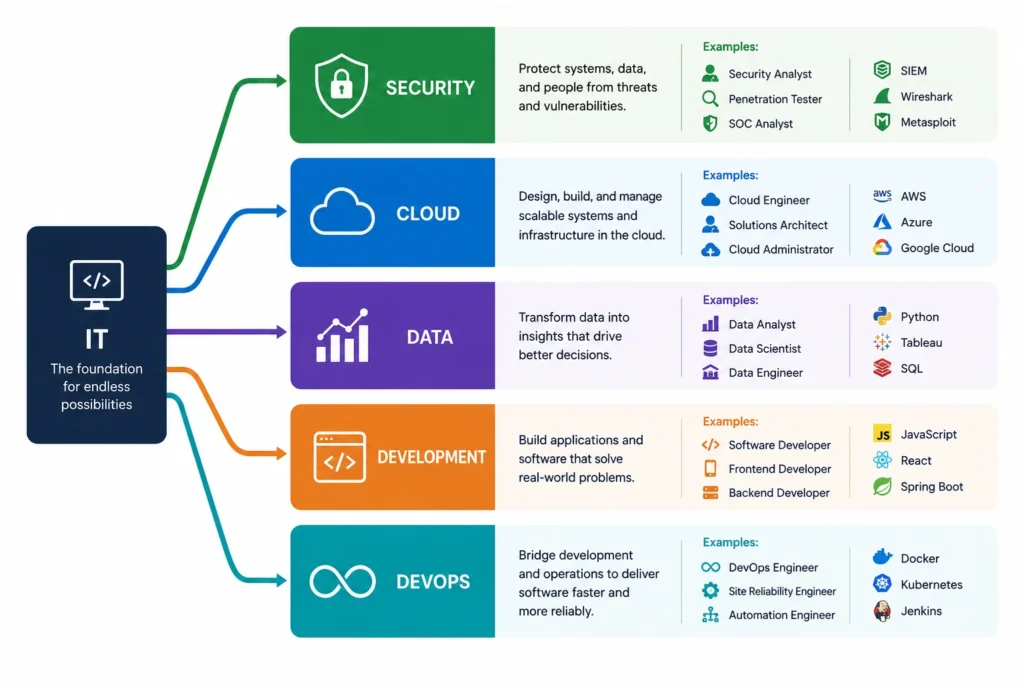
Ask ten people what “working in IT” actually means, and you will likely get ten different answers.
Furthermore, information technology work can mean anything from resolving an employee’s internet connection issues to programming an organisation’s entire cloud infrastructure from scratch. Because the field is so genuinely diverse, the skills and daily responsibilities vary enormously depending on which specific path you choose.
Consequently, the real challenge for anyone entering or advancing in IT is not learning “IT skills” generically — it is identifying which specific career path matches your interests and strengths, then building the targeted skill set that path actually requires. Furthermore, chasing every trending technology simultaneously spreads your effort too thin, while committing deliberately to one path lets you build genuine, hireable depth.
In this guide, we break down the top IT career paths available today, the specific skills each one demands, and practical ways to build those skills whether you are just starting out or pivoting from another role. Furthermore, understanding these distinct paths helps you make a genuinely informed decision rather than guessing your way through a technology career.
Why Choosing the Right IT Path Matters More Than Chasing Trends
The Problem With Trying to Learn Everything
Furthermore, the sheer breadth of IT tempts many newcomers into trying to learn a little of everything — a bit of coding, some cloud basics, introductory security concepts — without genuinely mastering any single area. Consequently, this scattered approach produces candidates who sound broadly informed in interviews but struggle to demonstrate the depth employers specifically hire for.
Depth Beats Breadth for Landing Your First Serious Role
Furthermore, employers hiring for a network administrator role want genuine confidence in someone’s ability to manage LANs, WANs, and VPNs — not a passing familiarity alongside five other unrelated skill areas. Consequently, choosing one path and building real depth there, even while maintaining broader awareness of adjacent fields, produces significantly stronger job candidates than generalized, shallow knowledge across everything.
Path 1: Cybersecurity — Protecting What Everything Else Depends On
Security should be foundational to any IT team, and it increasingly stands as its own dedicated career path rather than a side responsibility.
What This Path Actually Involves
Furthermore, cybersecurity professionals work across physical, network, and software security — installing firewalls and routers, implementing data encryption, developing risk mitigation strategies, and conducting threat analysis. Moreover, many security roles also involve ethical hacking and penetration testing, actively probing systems for vulnerabilities before genuine attackers find them first.
Core Skills to Build
✅ Network and software security fundamentals
✅ Firewall and router configuration
✅ Data encryption principles
✅ Compliance regulations and standards knowledge
✅ Ethical hacking and penetration testing
Getting Started
Many cybersecurity professionals begin in help desk, networking, or system administration roles, since these positions introduce foundational concepts directly relevant to security work. Furthermore, entry-level certifications like CompTIA Security+ provide structured, employer-recognized proof of foundational knowledge before moving into dedicated security analyst positions.
Path 2: Software Development — Building the Tools Everyone Else Uses
Programming remains necessary for anyone who wants to develop software, web applications, and websites, while also proving valuable for IT professionals who want to automate repetitive tasks.
What This Path Actually Involves
Furthermore, software developers write efficient, maintainable code that automates processes and takes advantage of established coding practices to deliver convenience across every industry. Moreover, quality assurance work — checking code for opportunities to reduce load speeds or unnecessary length — is genuinely valued by employers seeking developers who write production-ready code, not just functional prototypes.
Core Skills to Build
✅Python — widely applicable across web, data, and automation work
✅ JavaScript — essential for web development specifically
✅ C++ and Kotlin — valuable for systems and mobile development respectively
✅ Version control and collaborative coding practices
✅ Debugging and code optimization
Getting Started
Furthermore, writing a research paper or final project during formal studies, participating in coding bootcamps, or contributing to open-source projects all provide genuine, demonstrable proof of coding ability. Consequently, building a portfolio of real projects matters significantly more to hiring managers than certifications alone in this particular path.
Path 3: Cloud Computing — Where Nearly Everything Is Heading
Cloud computing skills are among the most in-demand in the entire IT field, spanning everything from building cloud infrastructure to maintaining it long-term.
What This Path Actually Involves
Furthermore, cloud professionals work with platforms like AWS, Google Cloud, Microsoft Azure, and Oracle to build application programming interfaces, integrate services onto cloud platforms, and manage the infrastructure that increasingly replaces traditional on-premises servers. Moreover, this path opens doors specifically to positions like cloud developer, cloud administrator, and cloud architect — each with distinct responsibilities but shared foundational knowledge.
Core Skills to Build
✅ At least one major cloud platform (AWS, Azure, or Google Cloud)
✅ API development and integration
✅ Cloud security and access management
✅ Cost optimization and resource management
✅ Basic DevOps and automation concepts
Getting Started
Furthermore, most major cloud providers offer their own certification tracks — genuinely valuable credentials that directly signal platform-specific competence to employers. Consequently, choosing one platform to specialize in initially, rather than spreading effort across all three major providers simultaneously, builds deeper, more hireable expertise faster.
Path 4: Data Analysis and Database Management — Making Sense of Information
Being able to analyse data proves useful for a genuinely wide range of IT tasks, and monitoring performance data specifically helps teams identify security threats or operational inefficiencies before they become serious problems.
What This Path Actually Involves
Furthermore, database administrators and data engineers work with large datasets to add, store, and access information efficiently for analysis or to feed data into other software systems. Moreover, this work often involves designing database models based on specific project requirements and granting remote, secure access to team members working across different locations.
Core Skills to Build
✅ SQL — the foundational language for database querying
✅ Statistics and data interpretation
✅ Python for data analysis and automation
✅ Database design and modeling
✅ Data visualization tools
Getting Started
Furthermore, this path suits candidates who enjoy working with numbers and finding meaningful patterns within large, sometimes messy datasets. Consequently, building small personal projects — analyzing publicly available datasets and presenting findings clearly — demonstrates genuine analytical capability to prospective employers.
Path 5: DevOps — Bridging Development and Operations
DevOps — a combination of “development” and “operations” — acts as a genuine bridge between software development teams and IT operations, and has grown into a distinct, high-demand specialization of its own.
What This Path Actually Involves
Furthermore, DevOps professionals need a genuine understanding of continuous delivery theory, container technologies like Docker or Kubernetes, and scripting languages including Python, Ruby, and C. Moreover, familiarity with cloud operations connects this path directly to cloud computing skills, making the two areas naturally complementary for career growth.
Core Skills to Build
✅ Continuous integration and continuous delivery (CI/CD) concepts
✅ Container technologies — Docker and Kubernetes specifically
✅ Scripting for automation
✅ Cloud platform familiarity
✅ Infrastructure as code principles
Getting Started
Furthermore, DevOps roles typically favor candidates with some prior experience in either development or systems administration, since the role genuinely requires understanding both perspectives to bridge them effectively. Consequently, this path often suits professionals pivoting from an existing IT role rather than complete beginners.
Path 6: Systems and Network Administration — Keeping the Foundation Running
Making sure computer systems and networks operate smoothly sits at the genuine center of most IT team responsibilities, and system and network administrators typically specialize specifically in this foundational skill set.
What This Path Actually Involves
Furthermore, this work includes administering diverse operating systems like Windows, Linux, or macOS, installing and configuring hardware and software, and maintaining local area networks, wide area networks, storage area networks, and virtual private networks. Moreover, troubleshooting and directly helping employees resolve technical issues remains a core, ongoing responsibility in this path.
Core Skills to Build
✅ Multi-platform operating system administration
✅ Network configuration and troubleshooting
✅ Hardware installation and maintenance
✅ VPN and remote access management
✅ Clear technical communication with non-technical staff
Getting Started
Furthermore, hardware deployment experience — ordering, unpacking, and setting up IT systems, then troubleshooting issues as they arise — provides genuinely practical, hands-on experience that translates directly into this career path. Consequently, entry-level help desk positions frequently serve as the natural starting point before advancing into dedicated systems or network administration roles.
Path 7: Machine Learning and AI — The Fastest-Growing Specialization
Machine learning, a subset of artificial intelligence, has become one of the most prominent and fastest-growing skills to learn across the entire technology sphere.
What This Path Actually Involves
Furthermore, ML-focused IT professionals use statistical models built on probability and data modeling concepts to apply artificial intelligence technologies to real business problems. Moreover, this might involve accumulating and studying large quantities of data to build predictive algorithms — forecasting housing prices in a specific region, for example, or predicting customer behavior patterns.
Core Skills to Build
✅ Parametric and nonparametric algorithms
✅ Deep learning techniques and neural network architectures
✅ Clustering and pattern recognition
✅ Strong Python programming foundation
✅ Linear algebra and statistical modeling
Getting Started
Furthermore, participating in machine learning projects during college coursework or an internship provides genuinely valuable, demonstrable experience worth highlighting prominently on a resume. Consequently, this path typically requires the strongest mathematical and programming foundation of any career path in this guide, making it well-suited to candidates coming from computer science or statistics backgrounds specifically.
Comparing These 7 IT Career Paths at a Glance
| Career Path | Core Skill Focus | Best Entry Point |
|---|
| Cybersecurity | Network security, software security, encryption | Start with a help desk or networking role |
| Software Development | Programming languages, code quality, software engineering | Build portfolio projects or attend coding bootcamps |
| Cloud Computing | AWS, Azure, Google Cloud, API integration | Earn a platform-specific cloud certification |
| Data Analysis | SQL, statistics, Python, data visualization | Work on personal data analysis projects |
| DevOps | CI/CD pipelines, Docker, Kubernetes, scripting | Gain prior development or system administration experience |
| Systems/Network Administration | Operating systems, server management, networking | Begin with an entry-level help desk position |
| Machine Learning / AI | Statistics, deep learning, Python, AI frameworks | Develop a strong foundation |
Building Both Technical and Soft Skills
Why Soft Skills Matter Alongside Technical Depth
Furthermore, while technical skills help with programming, repairing hardware, and setting up databases, IT soft skills teach professionals to maintain organised, professional work standards throughout their careers. Moreover, demonstrating strong organisation and problem-solving abilities in the workplace lets team members and senior employees genuinely trust your project management and leadership potential — qualities that matter enormously for career advancement beyond entry-level roles.
Four Practical Ways to Build Real Skills
Teach yourself through structured online learning. Furthermore, many programming languages, data analysis techniques, and IT fundamentals are genuinely learnable through self-study using online courses or home projects.
Pursue relevant certifications. Furthermore, certifications provide employer-recognized proof that your abilities meet established professional standards, typically requiring focused study and a passing exam score.
Consider intensive bootcamps. Furthermore, bootcamps generally run several weeks to months, delivering specific, job-ready skills quickly — popular particularly for coding and cybersecurity specializations.
Pursue a structured degree program. Furthermore, while more time-consuming than other options, a computer science or related degree provides a structured path to gain the technical foundation many advanced IT roles eventually require.
Putting Your Chosen Path Into Action
Update Your Resume and Professional Profiles
Furthermore, once you have built genuine skills in your chosen path, update your resume and LinkedIn profile specifically to reflect your new credentials and demonstrated capabilities. Consequently, quantifying your accomplishments wherever possible — projects completed, systems managed, problems solved — makes your experience concrete rather than abstract.
Prepare Real Examples for Interviews
Furthermore, come prepared with specific stories about how you have applied your skills in practice, even if that practice happened only through coursework or personal projects rather than formal employment. Moreover, being ready to describe exactly what you accomplished, including challenges you overcame, demonstrates genuine capability far more convincingly than simply listing skills on paper.
Gain Hands-On Experience Through Real Projects
Furthermore, internships remain one of the most valuable ways to apply classroom learning to real-world projects while receiving direct feedback from industry professionals. Moreover, joining online IT communities specific to your chosen path keeps you updated on emerging tools, common problems, and solutions other professionals are actively discussing.
Conclusion
Information technology offers genuinely more career paths than most newcomers realize, and each one demands a distinct combination of skills, interests, and entry strategies.
Cybersecurity protects what everything else depends on. Software development builds the tools people use daily. Cloud computing powers the infrastructure modern business increasingly runs on. Data analysis and database management make sense of the information organizations collect. DevOps bridges development and operations. Systems and network administration keeps the foundational infrastructure running smoothly. Machine learning and AI represent the fastest-growing frontier of the entire field.
Furthermore, none of these paths require you to master everything simultaneously. Consequently, the most successful IT professionals choose one path deliberately, build genuine, demonstrable depth through real projects and relevant certifications, and only then expand into adjacent skills as their career naturally evolves.
Therefore, identify which of these seven paths genuinely excites you most. Build the specific skills that path demands. Gain real, hands-on experience through internships, projects, or community involvement. Consequently, you position yourself for the successful, sustainable IT career this rapidly evolving field genuinely offers.
Frequently Asked Questions (FAQs)