Table of Contents

Introduction

Website security has become one of the biggest priorities for businesses in 2025. Whether you run a blog, an eCommerce store, or a corporate website, securing user data is essential. This is where encryption protocols like SSL and TLS come into play. Although many people use the term SSL certificate, modern web security is actually powered by TLS. In this blog, we will break down SSL vs TLS, how they work, their differences, and why TLS is the recommended security protocol today.

What Is SSL (Secure Sockets Layer)?

SSL, or Secure Sockets Layer, is an older web security protocol developed in the 1990s to encrypt communication between browsers and servers. Its main purpose was to prevent hackers from intercepting sensitive information such as passwords, credit card numbers, and personal data.
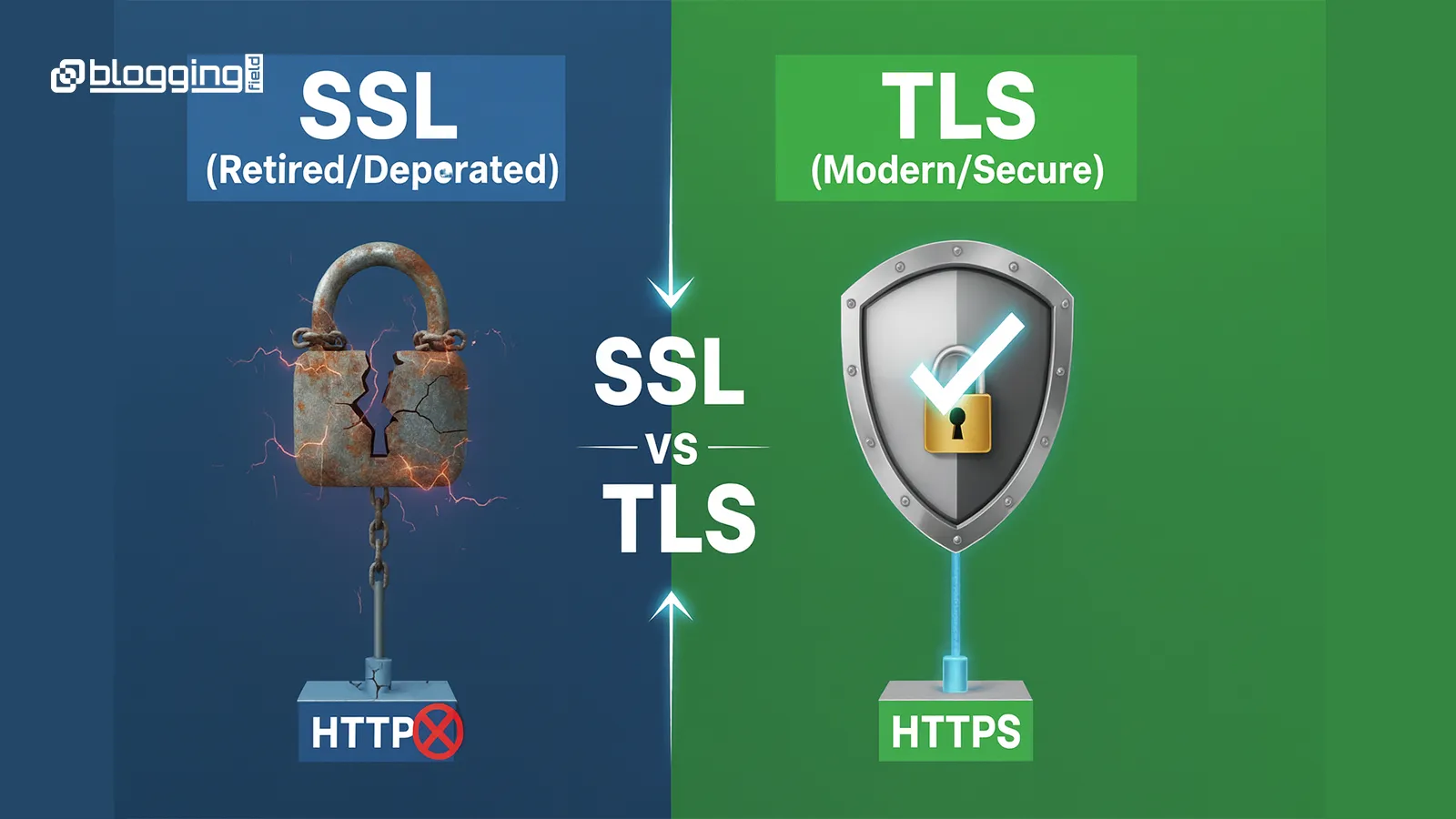
However, SSL had several security vulnerabilities that made it outdated. SSL 2.0 and SSL 3.0 are now considered insecure and have been completely deprecated. Modern browsers no longer support them. Today, when you hear the term “SSL certificate,” it usually refers to a TLS-powered certificate, but the name SSL is still widely used in the industry due to familiarity.

What Is TLS (Transport Layer Security)?

TLS, or Transport Layer Security, is the modern and more secure version of SSL. Developed as an upgrade to SSL, TLS offers stronger encryption algorithms, improved performance, and enhanced protection against cyberattacks such as MITM (Man-in-the-Middle) and protocol downgrades.
TLS has gone through several versions, with TLS 1.2 and TLS 1.3 being the most widely used today. TLS 1.3 is significantly faster and more secure because it reduces the handshake time, supports only strong encryption methods, and eliminates outdated cryptographic techniques.

SSL vs TLS: Key Differences

Although SSL and TLS serve the same purpose—encrypting data—their internal functioning and security levels differ.

1. Security Level

SSL is vulnerable and outdated, while TLS is robust and secure.
TLS uses advanced cryptographic algorithms such as AEAD, which makes it resistant to modern cyberattacks.

2. Handshake Process

TLS uses a more efficient handshake mechanism that reduces latency and improves load times.
SSL has a slower handshake process and is more vulnerable to downgrade attacks.

3. Encryption Strength

TLS supports stronger cipher suites and only uses modern encryption algorithms.
SSL uses weak encryption that can be cracked using today’s computing power.

4. Alerts & Messages

TLS uses detailed and clear alert messages when errors occur, making debugging easier.
SSL uses simpler, often unclear alert messages.

5. Version Support

SSL versions (SSL 1.0, 2.0, 3.0) are deprecated.
TLS versions (1.0 to 1.3) are actively used, with TLS 1.3 being the industry standard.

Why TLS Is the Better Choice in 2025

TLS is considered the ultimate replacement for SSL due to several reasons:

1. Highest Level of Security

TLS 1.3 eliminates insecure cipher suites and offers end-to-end encryption with minimal risk of data breaches.

2. Faster Performance

TLS reduces handshake time, improving website speed — which also boosts SEO ranking.

3. Browser and Server Compatibility

All major browsers (Chrome, Firefox, Edge, Safari) fully support TLS and reject SSL connections.

4. Mandatory for HTTPS

Modern HTTPS connections are powered only by TLS, not SSL.

5. Better User Trust

Users are more confident when they see the padlock icon and HTTPS in the URL bar, powered by TLS.

How SSL/TLS Works

When a user visits a website with HTTPS enabled, the server and browser perform a handshake:

  1. Browser requests a secure connection

  2. Server sends its SSL/TLS certificate

  3. Browser verifies the certificate

  4. Both agree on encryption methods

  5. Secure, encrypted communication begins

TLS makes this process faster, more efficient, and more secure than the old SSL protocol.

Comparison Table: SSL vs TLS

FeatureSSLTLS
Security LevelWeakStrong
SpeedSlowerFaster
Supported CiphersOutdatedModern
HandshakeComplex, slowEfficient
StatusDeprecatedActive & Required
Used in HTTPS?NoYes

Do SSL Certificates Actually Use TLS?

Yes!
Even though companies still market them as “SSL Certificates,” they actually use TLS encryption. The term SSL is simply an industry-friendly name.

When you buy an SSL certificate in 2025, you are actually using TLS 1.2 or TLS 1.3 to secure your website.


Conclusion

Understanding the difference between SSL and TLS is essential for anyone managing a website in 2025. While SSL laid the foundation for secure web communication, it is now outdated and vulnerable. TLS is the modern, secure, and efficient protocol powering today’s HTTPS connections. If you want the highest level of protection for your site, users, and data, then you should always choose TLS—preferably TLS 1.3.

Frequently Asked Questions (FAQs)

No. SSL is completely outdated and no longer supported by modern browsers. Today’s security uses TLS.
For branding and simplicity. Even though the technology behind it is TLS, the name SSL certificate is still widely used.
TLS is far more secure due to stronger encryption, faster handshakes, and modern cryptographic algorithms.

Continue reading

Laravel

Laravel in 2025: Trends Every Developer Should Know

Introduction Laravel continues to dominate the PHP ecosystem in 2025 as one of the most powerful, elegant, and developer-friendly frameworks for building modern web applications. With continuous innovation, strong community support, and rapid adoption of emerging technologies, Laravel has evolved far beyond a traditional MVC framework. Today, it powers SaaS

Read More »
Scroll to Top