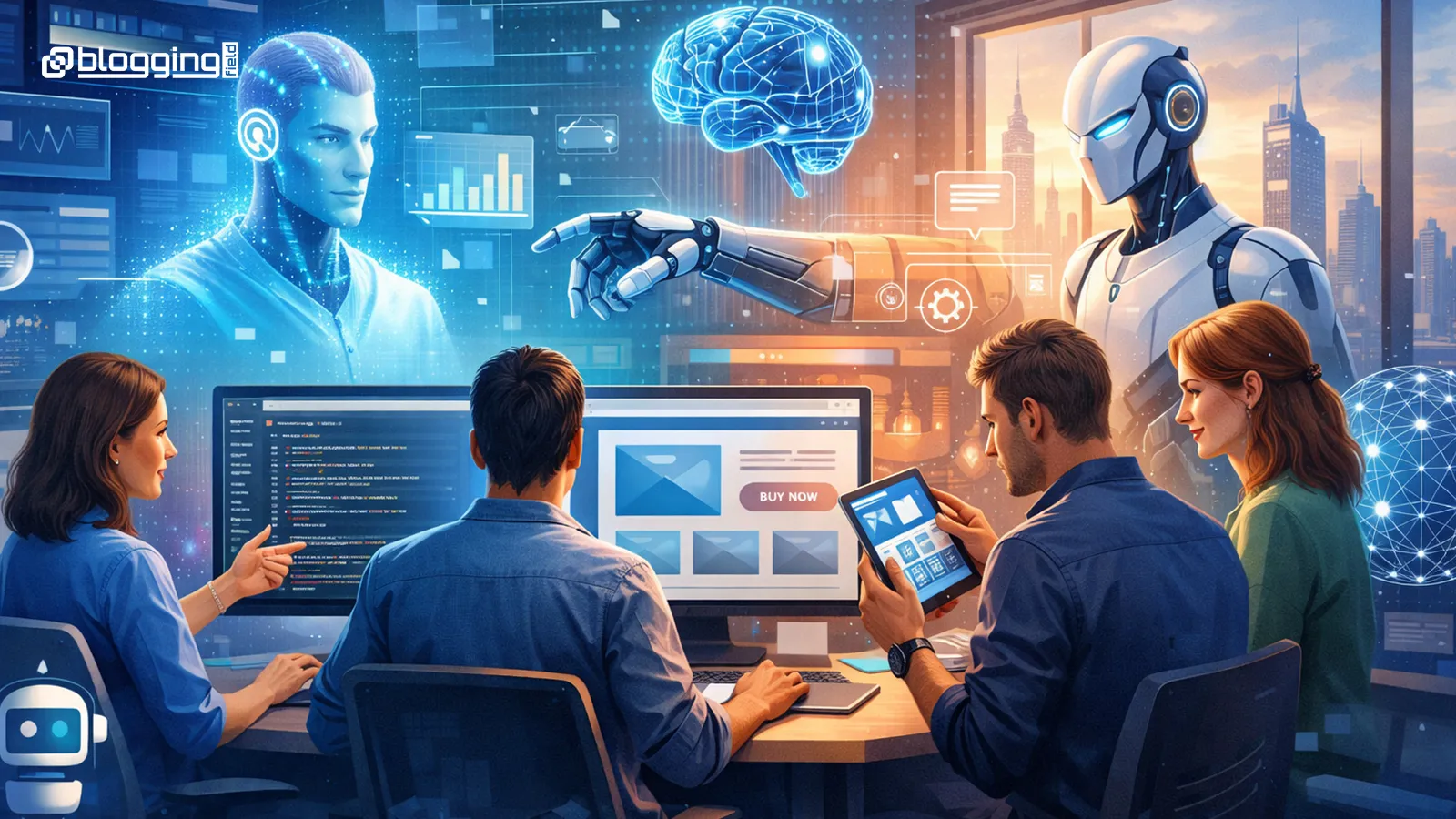
Artificial Intelligence (AI) is no longer a futuristic concept in web development—it is now a standard expectation. According to multiple 2025 web development industry surveys, clients are increasingly aware of AI-driven capabilities and expect agencies to deliver faster, smarter, and more personalized digital experiences. Businesses no longer judge developers only by design aesthetics or technical skills; they now measure success by automation, performance optimization, data-driven decisions, and AI-powered features.
This shift has fundamentally changed how clients evaluate web development agencies. From AI-powered chatbots and predictive UX to automated testing and content generation, clients now expect websites to be intelligent, scalable, and conversion-focused from day one. In this article, we explore how AI is changing client expectations in web development, backed by 2025 survey findings, and what agencies must do to stay ahead.
Recent 2025 industry surveys involving digital agencies, SaaS founders, and enterprise clients highlight a clear trend: AI is influencing buying decisions more than ever before. A majority of surveyed clients stated that they prefer agencies that actively use AI tools in their development workflows. Clients associate AI adoption with faster delivery, better performance, and reduced long-term costs.
Another critical finding shows that clients now expect AI recommendations during the planning phase itself. Instead of asking “Can you build this?”, clients ask “How can AI improve this?”. Businesses want agencies to suggest AI-based solutions for personalization, analytics, customer support, and marketing automation. This marks a shift from execution-based development to consultative, AI-driven web strategy.
One of the biggest changes in client expectations is speed. In 2025, clients expect websites to be designed, developed, and optimized faster than ever. AI-powered tools such as automated code generation, design assistants, and AI testing platforms have significantly reduced development timelines. As a result, clients assume faster delivery is standard—not a premium service.
Survey data indicates that clients are less tolerant of long development cycles unless the project is highly complex. AI tools for wireframing, UI generation, bug detection, and deployment automation have reshaped timelines. Agencies that fail to adopt AI-assisted workflows are often perceived as outdated or inefficient, even if their work quality is high.
Clients increasingly request features such as AI-powered product recommendations, dynamic content blocks, personalized landing pages, and predictive search. They expect developers to integrate AI tools with CRM systems, analytics platforms, and marketing automation tools. This expectation is especially strong in eCommerce, SaaS, healthcare, and education sectors, where personalization directly impacts conversions and engagement.
Clients want developers to use AI to predict user behavior, reduce friction points, and improve accessibility. AI-powered UX testing tools can identify drop-off points and usability issues before launch, which has changed how clients measure success. Websites are expected to be continuously optimized using AI—not redesigned every few years.
Clients are also demanding automation beyond chatbots, including AI-powered contact forms, smart notifications, automated email triggers, and AI-based CRM integrations. These features are seen as essential for improving customer experience and reducing operational costs. Agencies that cannot implement these solutions risk losing clients to AI-first competitors.
Performance and SEO expectations have significantly increased due to AI. Clients now expect websites to load faster, rank higher, and adapt automatically to search engine algorithm updates. AI-based performance optimization tools, image compression, lazy loading, and Core Web Vitals monitoring are no longer optional.
Survey data indicates that clients prefer agencies that use AI for keyword research, content optimization, schema generation, and technical SEO audits. AI-driven SEO strategies are viewed as more reliable and scalable. As a result, web development is now tightly connected with AI-powered SEO execution.
Clients in 2025 are more concerned about data privacy and security, especially when AI is involved. Surveys show that clients expect developers to implement AI-driven security monitoring, automated vulnerability scanning, and compliance checks.Clients in 2025 are more concerned about data privacy and security, especially when AI is involved. Surveys show that clients expect developers to implement AI-driven security monitoring, automated vulnerability scanning, and compliance checks.
With stricter data protection regulations globally, clients expect agencies to proactively manage AI risks. Secure AI integrations, ethical AI usage, and transparent data handling practices have become key decision-making factors when hiring a web development partner.
To meet evolving expectations, agencies must reposition themselves as AI-enabled digital partners rather than traditional developers. This means investing in AI tools, training teams, updating workflows, and clearly communicating AI capabilities to clients.
Agencies that embrace AI in design, development, testing, SEO, and maintenance are more likely to win long-term contracts. Clients now value strategic guidance, automation expertise, and AI-driven optimization over basic development services. In 2025, adaptability is no longer optional—it is essential for survival.
The 2025 survey findings clearly show that AI has redefined what clients expect from web development agencies. Clients no longer want just a website—they want a smart, adaptive, high-performing digital platform powered by AI. From personalization and automation to SEO and security, AI is now at the core of modern web development expectations.
Agencies that embrace AI as a strategic advantage will thrive, while those that resist change risk becoming irrelevant. In 2025 and beyond, success in web development depends on how effectively AI is used to deliver value, innovation, and measurable business results.