Installing another app is rarely the answer to a struggling Shopify store.
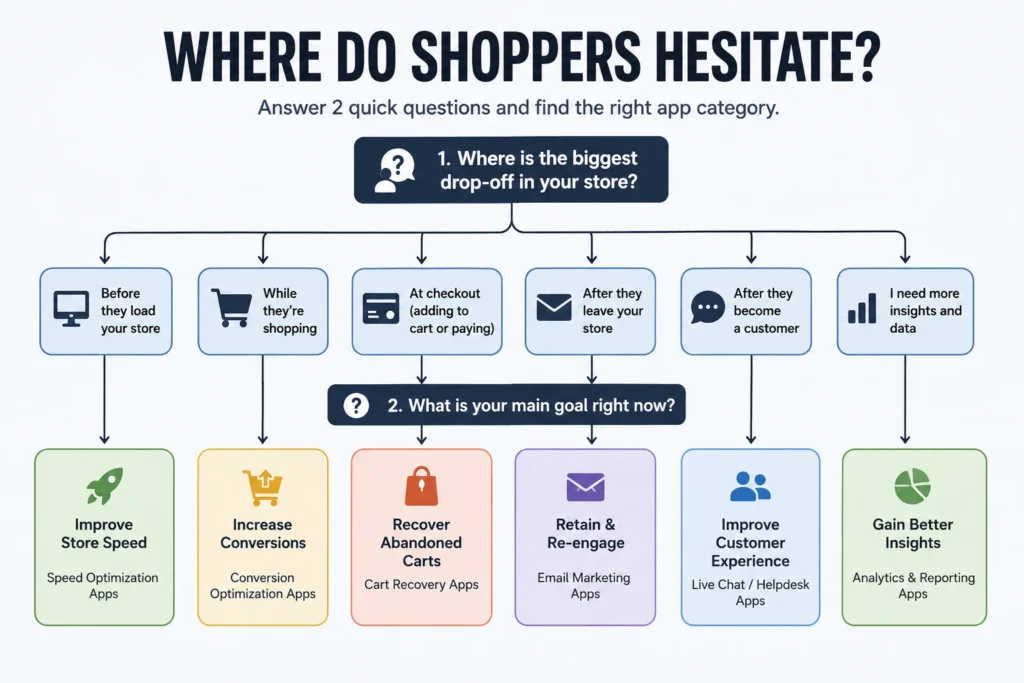
Furthermore, conversion rate optimization is rarely about adding more tools to your tech stack — in many cases, installing another app without addressing underlying friction simply adds complexity without improving performance. Consequently, the store owners who see real conversion improvements are not the ones with the most apps installed. They are the ones who understand exactly where shoppers hesitate and choose tools that remove that specific friction.
Effective conversion optimization is about understanding how shoppers actually move through your store, where they pause, and what stops them from taking the next step. Furthermore, the right apps support this process by removing friction, reducing uncertainty, and helping shoppers move confidently from product discovery through to checkout.
In this guide, we cover the Shopify apps that genuinely move the needle on conversion — what specific problem each one solves, when to use it, and the mistakes that turn a promising app into wasted subscription cost. Furthermore, each app here is included because it supports a distinct part of the buying journey, not because it is trendy.
Which App Should You Prioritize First?
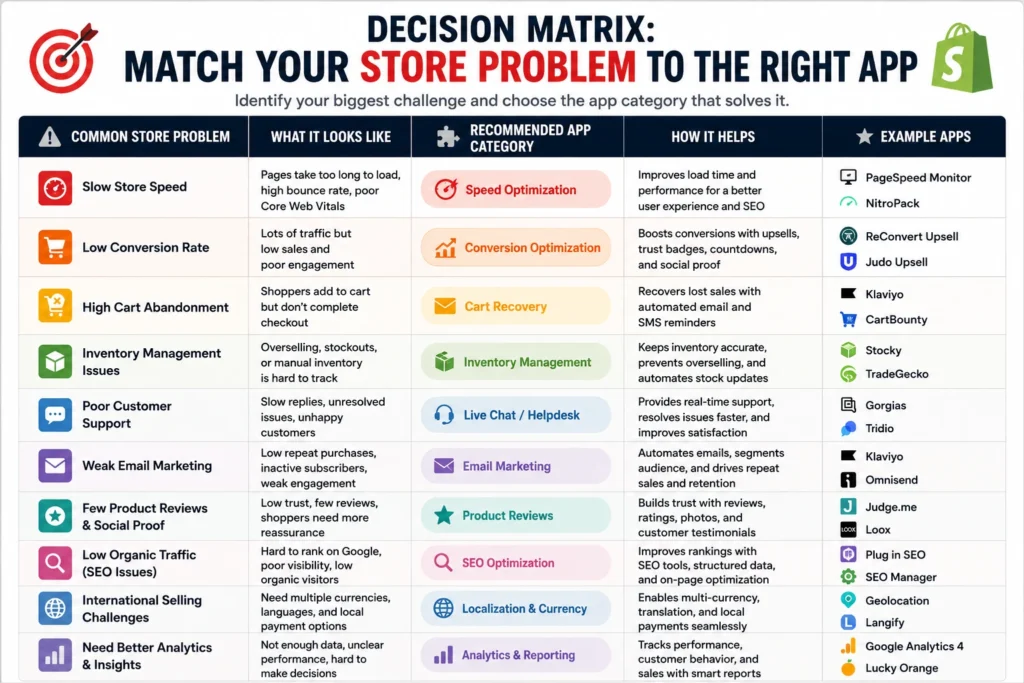
Before installing anything, identify your actual bottleneck. Furthermore, the table below maps common store problems directly to the app most likely to help — a genuinely useful starting point before you spend a single subscription dollar.
| Situation / Store Problem | Recommended App Category | Why It Helps |
|---|
| Slow-loading store | Speed optimization app | Improves page load times, enhancing user experience and SEO. |
| Low conversion rate | Conversion optimization app | Increases sales through features like upsells, urgency timers, and trust badges. |
| High cart abandonment | Cart recovery app | Recovers potentially lost sales with automated abandoned cart emails or SMS. |
| Inventory management issues | Inventory management app | Tracks stock levels, prevents overselling, and automates inventory updates. |
| Poor customer support | Live chat / Helpdesk app | Provides real-time assistance, improving customer satisfaction and retention. |
| Weak email marketing | Email marketing app | Automates campaigns, promotions, and customer follow-ups to boost repeat purchases. |
| Limited product reviews | Product review app | Builds trust with customer ratings, reviews, and user-generated content. |
| SEO and low organic traffic | SEO optimization app | Improves search engine visibility through metadata, structured data, and optimization tools. |
| International selling challenges | Currency & translation app | Supports multiple currencies and languages for global customers. |
| Need for analytics and insights | Analytics & reporting app | Tracks store performance, customer behavior, and sales trends for better decisions. |
Furthermore, this framework helps avoid the common trap of installing tools reactively instead of addressing the genuine root cause of conversion friction.
8 Shopify Apps That Genuinely Move Conversion
1. Rebuy
Best for: Increasing average order value and reducing decision fatigue across product pages, cart, and post-purchase.
Rebuy is a personalization and revenue optimization platform designed to power upsells, cross-sells, bundles, and post-purchase offers across your storefront. Furthermore, it uses customer behavior, cart context, and product relationships to surface relevant recommendations at exactly the right moments in the buying journey — driven either by its AI recommendation engine or custom rules you define.
Why Rebuy Genuinely Helps Conversion
Furthermore, Rebuy reduces decision friction at high-intent moments. When relevant recommendations appear inside the buying flow, shoppers quickly see what complements their purchase without needing to browse elsewhere or restart their journey. Moreover, contextual logic consistently outperforms generic “related products” — pairing a cleanser with the correct toner, or a protein powder with a matching shaker, rather than showing unrelated bestsellers.
Consequently, the key insight is restraint: fewer, more relevant recommendations outperform aggressive stacking every time. Rebuy is most effective when it reinforces intent the shopper already has, not when it introduces new decisions.
2. Yotpo
Best for: Building trust, credibility, and reducing buyer hesitation.
Yotpo is a customer content platform that helps brands collect, manage, and display reviews, star ratings, photo and video user-generated content, and Q&A across product and collection pages. Furthermore, it turns customer feedback into a visible trust layer that supports shoppers while they are still deciding whether to buy.
Why Yotpo Genuinely Helps Conversion
Furthermore, shoppers often hesitate because they do not yet trust the product, the brand, or whether it will genuinely work for them. Reviews and user-generated content reduce that perceived risk by validating quality, fit, and real-world use. Moreover, how reviews are surfaced matters more than volume alone — highlighting recent, product-specific reviews near the primary call-to-action consistently outperforms burying unstructured reviews far below the fold.
Consequently, reviews do not convert customers on their own. They work specifically when they reinforce a decision the shopper is already close to making.
3. Octane AI
Best for: Product discovery and reducing choice overload.
Octane AI enables brands to build guided product-finder quizzes that recommend products based on preferences, goals, routine, size, or gifting needs. Furthermore, these quizzes help shoppers narrow down options quickly and confidently when a catalogue feels genuinely overwhelming — acting like a digital sales associate.
Why Octane AI Genuinely Helps Conversion
Furthermore, when shoppers face too many options, decision-making slows and abandonment increases. A well-designed quiz translates a shopper’s needs into one clear, relevant recommendation rather than asking them to compare products independently. Moreover, the zero-party data collected through quiz responses — willingly provided by the shopper — offers a genuinely reliable signal for personalizing future email and SMS communication.
Consequently, quizzes work best when they lead to one clear recommendation with a defined next step, not multiple options that add another layer of decision-making.
4. Videowise
Best for: Product education, objection handling, and visual confidence.
Videowise allows brands to add shoppable video content across product pages, collections, and landing pages — including user-generated video, tutorials, demonstrations, and before-and-after content specifically designed to support purchase decisions.
Why Videowise Genuinely Helps Conversion
Furthermore, video addresses some of the most common reasons shoppers hesitate — uncertainty around fit, texture, scale, usage, and expected results. These are things static images and written copy often struggle to communicate clearly. Moreover, shoppable formats keep shoppers in a purchasing mindset, allowing discovery and decision-making to happen simultaneously rather than requiring a separate research step.
Consequently, Videowise requires ongoing content management — videos do not automatically push into on-site widgets, and outdated video libraries quickly lose their impact without a clear content ownership plan.
5. Boost AI Search & Filter
Best for: Product discovery on large or complex catalogues.
Boost AI Search & Filter enhances on-site search and collection filtering by making product discovery faster, more accurate, and more forgiving — adding typo tolerance, synonyms, smarter result ranking, and advanced filtering logic.
Why Boost AI Genuinely Helps Conversion
Furthermore, shoppers who use search are typically high-intent. They know what they are looking for and are often close to making a purchase. Consequently, if they cannot find the product quickly, they do not browse further — they simply leave. Moreover, Boost AI reduces “no results” outcomes caused by typos or informal phrasing, helping shoppers land on the right product page faster.
Therefore, strong search does not create demand — it captures it. When product discovery fails, even the best product page or checkout experience never gets a chance to convert.
6. Microsoft Clarity
Best for: Identifying hidden conversion friction before making changes.
Microsoft Clarity is a free behavioral analytics tool providing session recordings, heatmaps, scroll depth data, and rage-click detection. Furthermore, it adds qualitative context to your existing analytics by showing how real shoppers actually interact with your site — not just where they drop off numerically.
Why Clarity Genuinely Helps Conversion
Furthermore, Clarity exposes friction that traditional analytics often miss entirely. Instead of relying on assumptions, teams can see exactly where shoppers hesitate, misclick, abandon forms, or struggle with broken interactions — clickable elements that appear interactive but are not, primary CTAs positioned below average scroll depth, or mobile interactions breaking due to overlapping elements.
Consequently, fixing issues Clarity reveals often leads to measurable conversion improvements without adding a single new feature or app — because it removes friction rather than adding complexity. Behavioral insight should genuinely precede tooling decisions, not follow them.
7. Gorgias
Best for: Pre-purchase support, buyer confidence, and assisted conversion.
Gorgias is a customer support platform built specifically for eCommerce, centralizing support across email, live chat, and social channels. Furthermore, beyond traditional support, it enables workflows and AI-assisted responses that reduce friction for shoppers before, during, and after purchase.
Why Gorgias Genuinely Helps Conversion
Furthermore, unanswered questions are one of the most common reasons shoppers abandon a purchase — delivery timelines, sizing, compatibility, and returns often arise at the exact moment a shopper is deciding whether to buy. Moreover, while Gorgias is often thought of as a post-purchase tool, its biggest conversion impact frequently happens before checkout, automatically answering high-volume questions that would otherwise cause abandonment.
Consequently, support is not separate from conversion. When shoppers feel genuinely helped, they feel confident enough to buy.
8. Growave
Best for: Increasing repeat purchases and customer lifetime value through loyalty, reviews, referrals, and wishlists in one platform.
Growave helps merchants convert more visitors into customers and more customers into repeat buyers by combining social proof and retention tools within a single system. Furthermore, product reviews reduce purchase hesitation, wishlists help recover lost buying intent, referrals turn existing customers into advocates, and loyalty rewards give shoppers genuine reason to return.
Why Growave Genuinely Helps Conversion
Furthermore, because these tools work together within one platform, merchants create a more connected customer journey without managing multiple disconnected apps. Consequently, Growave works best for brands focused specifically on retention and repeat purchase rate, alongside stores looking to consolidate several point solutions into one consistent system.
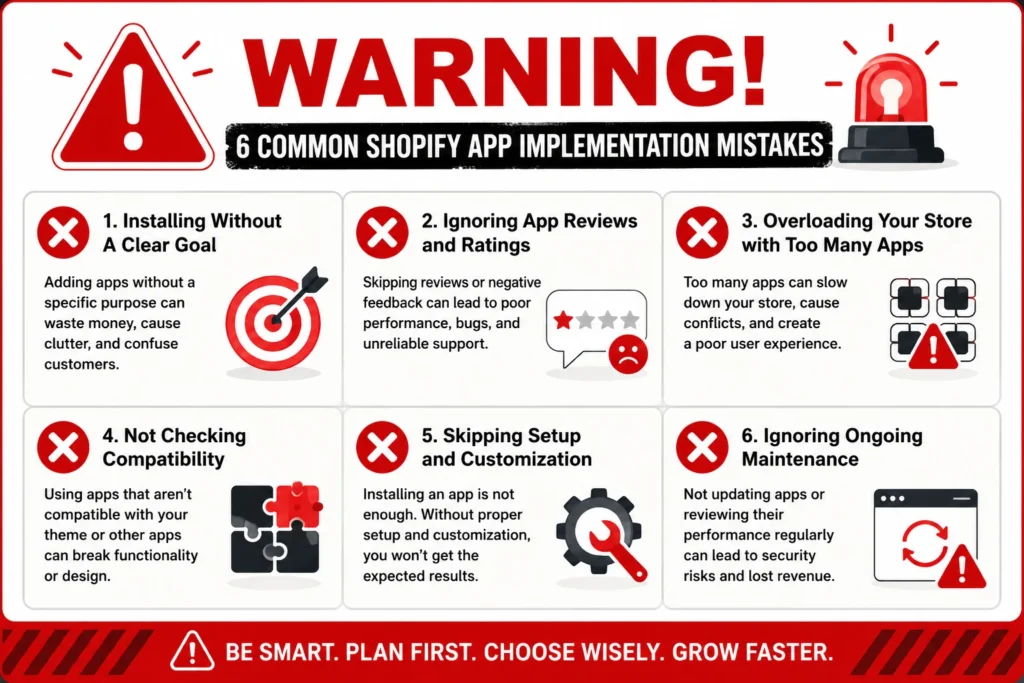
6 Common Mistakes That Waste These Apps' Potential
Shopify apps can be genuinely powerful conversion enablers, but only when chosen and implemented with real intent. Furthermore, many conversion issues are not caused by a lack of tools — they are caused by how, and why, tools get added in the first place.
Installing upsell tools before fixing product page clarity. Furthermore, upsells amplify existing momentum — they do not create it. If a product page does not clearly communicate value or address pricing objections, adding upsells in the cart often increases friction rather than revenue.
Showing too many recommendations and creating choice overload. Furthermore, more recommendations do not equal better conversion. Over-stacking product suggestions overwhelms shoppers and slows decision-making, while fewer, more relevant options consistently outperform broad, generic suggestions.
Adding quizzes without a clear recommendation outcome. Furthermore, quizzes only work when they guide shoppers toward one specific next step. Without a clear recommendation or call to action, a quiz becomes an extra interaction rather than a conversion aid.
Publishing reviews without moderation or relevance. Furthermore, social proof works best when it supports the specific product being viewed. Unfiltered or irrelevant reviews can distract shoppers or raise new objections instead of resolving existing ones.
Collecting behavioral data but never acting on it. Furthermore, tools like heatmaps and session recordings only create value when their insights translate into action. Data without action creates the illusion of progress while leaving genuine friction unresolved.
Adding new apps without auditing your existing tech stack. Furthermore, one of the most overlooked mistakes is installing new tools to solve problems your existing platform could already address through better configuration.
How to Choose Apps That Genuinely Support Conversion
Furthermore, before installing anything new, ask yourself three genuine questions. Can this issue be solved through better configuration of existing tools? Is the problem behavioral, UX-related, or technical rather than a tooling gap? Will this app remove genuine friction, or simply add complexity to an already crowded interface?
Consequently, apps amplify what already exists in your store. When the underlying experience is unclear or fragmented, adding more tools tends to magnify the problem rather than solve it. Moreover, the most effective Shopify conversion apps do not increase conversion on their own — they work specifically when they remove friction, reduce uncertainty, and support real buying behavior at key moments in the customer journey.
The Future of Shopify App Integration
The future of Shopify app integration is defined by AI-driven automation, seamless API updates, and new technologies that empower stores to deliver hyper-personalized and unified shopping experiences across every channel. In 2025, the most successful eCommerce brands are adopting AI apps that automate marketing, customer service, inventory management, and sales forecasting, saving time and maximizing revenue. Shopify’s latest updates include AI assistants like Sidekick for instant business insights, next-gen AI shopping agents, and security- and speed-enhanced checkout flows, all seamlessly enabled via app integrations.
Conclusion
The eight apps in this guide — Rebuy, Yotpo, Octane AI, Videowise, Boost AI Search & Filter, Microsoft Clarity, Gorgias, and Growave — each solve a genuinely distinct problem in the buying journey, from product discovery through to repeat purchase.
Furthermore, none of them guarantee results in isolation. They work specifically when aligned to real user behavior and clear business goals, reinforcing how shoppers already want to buy rather than forcing new behaviors or adding unnecessary complexity.
Consequently, the biggest conversion gains come from understanding exactly where and why shoppers hesitate first, then choosing the specific tool that removes that friction at the right moment. If you genuinely cannot identify which app would make a real impact on your store, that uncertainty itself is often the signal — it usually means your funnel needs reviewing before anything new gets implemented.
Therefore, start with Microsoft Clarity’s free insights to understand your actual friction points. Match your specific problem to the right app from this guide. Consequently, your Shopify store converts more consistently — not because you added more tools, but because you made better decisions about which ones genuinely matter.
Frequently Asked Questions (FAQs)