React powers some of the fastest, most responsive web applications on the internet.
However, React itself does not guarantee a fast, responsive application. Furthermore, the same library that produces elegant, high-performing dashboards in skilled hands produces bloated, hard-to-maintain applications in inexperienced ones. Consequently, the difference between a React project that delivers real business value and one that becomes a maintenance nightmare comes down almost entirely to who you hire to build it.
This distinction matters more than most businesses realize before they start interviewing candidates. A React application built without disciplined component architecture, proper state management, and performance optimization becomes genuinely difficult to scale or modify later — regardless of how impressive the initial demo looked.
In this guide, we walk through exactly how to choose the best ReactJS development partner — what questions to ask, how to evaluate technical capability, and which red flags experienced buyers recognize immediately but first-time hirers often miss. Furthermore, whether you are hiring a freelancer, a boutique agency, or a full development company, this guide gives you a clear, practical evaluation framework.
What Makes React Different — And Why Partner Choice Matters More
Before evaluating candidates, understand why ReactJS specifically demands careful partner selection.
React's Strengths Depend on Disciplined Implementation
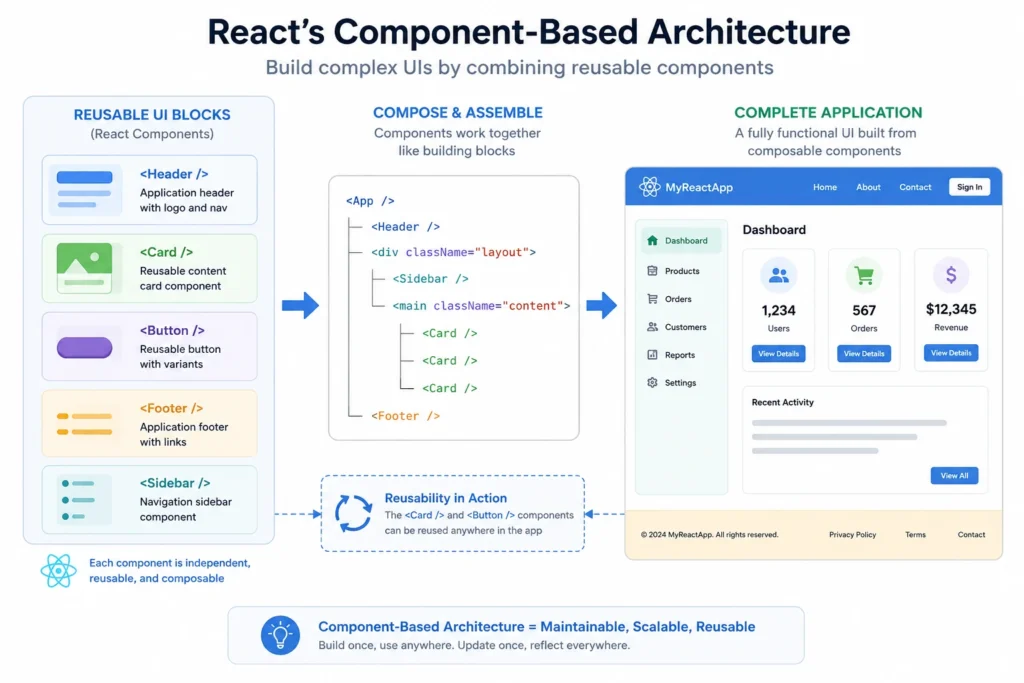
React’s component-based architecture lets developers divide the user interface into smaller, reusable pieces assembled to serve dynamic application requirements. Furthermore, this approach delivers genuine benefits — efficient rendering through the virtual DOM, enhanced developer productivity, and strong cross-platform compatibility. However, every one of these benefits depends entirely on components being architected thoughtfully from the start.
Why Poor React Architecture Becomes Expensive Later
An application with reusable, well-planned components scales smoothly as features get added. Furthermore, an application where every developer built components differently — inconsistent state management, unnecessary re-renders, tangled prop drilling — becomes progressively harder and more expensive to modify. Consequently, the partner you choose determines not just your launch timeline but your total cost of ownership for years afterward.
Freelancer vs Development Company for React Projects
Before searching for specific candidates, decide which category of partner your project genuinely needs.
| Factor | Freelancer | Development Company |
|---|
| Cost | Lower | Higher |
| Availability | Limited, single point of failure | Dedicated team with built-in redundancy |
| Specialization | Typically focused on one or two technologies | Full-stack expertise (React, backend, DevOps, QA) |
| Accountability | Relies on individual reputation | Backed by company processes and accountability |
| Scalability | Limited for larger or complex projects | Well-equipped to handle growing project scope |
| Best For | MVPs, small features, and budget-conscious projects | Production applications and enterprise-grade dashboards |
8 Questions to Ask Before Hiring a ReactJS Partner
These questions separate genuinely capable React partners from candidates who simply know the syntax.
Question 1: How Do You Approach Component Architecture?
This is the single most revealing question you can ask. Furthermore, a strong answer discusses breaking interfaces into small, reusable, single-responsibility components — and explains how they avoid prop drilling and unnecessary re-renders through proper state management. Consequently, a vague or generic answer here signals a candidate who writes React code without genuinely understanding React architecture.
Question 2: Which State Management Approach Do You Use, and Why?
React applications need a clear strategy for managing data as they grow beyond simple component-level state. Furthermore, ask specifically whether they default to Context API, Redux, Zustand, or another approach — and why they choose it for different project sizes. Moreover, a partner who applies the same heavy state management solution to every project regardless of complexity may be over-engineering smaller applications unnecessarily.
Question 3: How Do You Ensure Application Performance?
Performance is not automatic in React — it requires deliberate technique. Furthermore, strong candidates discuss code splitting, lazy loading, memoization, and avoiding unnecessary re-renders through tools like React.memo and useMemo. Consequently, ask for specific examples of performance problems they diagnosed and fixed on previous projects rather than accepting generic assurances.
Question 4: Do You Use Server-Side Rendering, and When?
Server-Side Rendering through frameworks like Next.js significantly improves both SEO and initial page load performance by pre-rendering HTML content before it reaches the browser. Furthermore, ask whether they default to Next.js for projects needing search visibility, or whether they only reach for SSR when specifically required. Consequently, understanding their SSR philosophy reveals whether they think about your business goals or just default to familiar tools.
Question 5: What Does Your Testing Process Look Like?
Untested React applications accumulate bugs that surface unpredictably as features get added. Furthermore, ask specifically about their use of testing tools — Jest, React Testing Library, or Cypress — and what percentage of components typically receive test coverage on their projects. Consequently, a team with no testing discipline creates technical debt that becomes expensive to untangle later.
Question 6: Who Owns the Code After Delivery?
Confirm explicitly, in writing, that you receive complete ownership of all code, repositories, and documentation upon project completion or final payment. Furthermore, some development partners retain rights to reusable components or frameworks they built, creating unexpected dependency. Consequently, clarifying ownership before signing prevents costly disputes later.
Question 7: What Does Post-Launch Support Include?
Ask specifically what counts as a bug fix versus a billable change request, and what the response time commitment looks like for critical issues. Furthermore, some partners include 30 to 90 days of free bug fixes; others charge hourly for everything immediately after delivery. Consequently, understanding this upfront prevents unpleasant surprises in the first week after launch.
Question 8: Can You Show Live, Working Applications — Not Just Screenshots?
Request functioning URLs from their portfolio rather than static case study images. Furthermore, test the actual application’s loading speed, responsiveness, and interaction smoothness yourself. Consequently, live applications reveal genuine technical capability that polished screenshots and marketing copy cannot fake.
What to Look for in a React Portfolio
Check for Genuine Complexity, Not Just Volume
Look specifically for dashboards, real-time features, or complex data-driven interfaces in their portfolio — not just marketing websites that happen to use React. Furthermore, real-time chat applications, live data dashboards, and applications using WebSockets demonstrate genuinely advanced React capability that simpler projects do not require.
Test Actual Application Performance
Open portfolio applications and specifically test their responsiveness. Furthermore, click through multiple interactions, resize the browser to check responsive behavior, and note whether the interface ever feels sluggish or unresponsive. Consequently, direct testing reveals far more than a case study description ever will.
Look for Industry-Relevant Experience
A candidate who has built dashboards for industries similar to yours understands your specific data visualization and workflow needs faster than one starting from zero domain knowledge. Furthermore, this relevant experience reduces both project timeline and the risk of costly requirement misunderstandings.
Red Flags to Watch For
🚩 Vague answers about state management — If a candidate cannot clearly explain when they would use Context API versus Redux, they likely have not built applications complex enough to require the distinction matter.
🚩 No mention of performance optimization techniques — Furthermore, if code splitting, lazy loading, and memoization never come up unprompted, performance was likely never a genuine priority on their previous projects.
🚩 Unwillingness to share live application links — A confident partner shares working URLs readily. Furthermore, reluctance to do so often signals limited genuine delivery experience.
🚩 No discussion of testing — Moreover, teams that skip testing entirely produce applications that become increasingly fragile as features accumulate over time.
🚩 Unclear code ownership terms — Consequently, always get ownership explicitly confirmed in writing before signing any contract.
🚩 Pricing dramatically below market rate — Furthermore, unusually cheap React development typically means junior developers learning on your project, inexperienced architecture decisions, or scope creep charged later to compensate for the low initial quote.
React Development Cost Considerations
React application costs vary enormously based on complexity, team seniority, and project scope. Furthermore, understanding what drives cost helps you evaluate proposals accurately rather than simply comparing bottom-line numbers.
| Factor | Impact on Cost |
|---|
| Application Complexity | Simple UI costs less than real-time dashboards or enterprise-grade systems. |
| Developer Seniority | Junior teams are more affordable but may introduce architectural challenges. |
| Backend Integration Needs | Custom API integrations significantly increase development scope and cost. |
| Timeline Urgency | Accelerated deadlines raise costs due to overtime or additional resources. |
| Testing and QA Depth | Thorough testing requires more time but minimizes post-launch issues. |
| Post-Launch Support Scope | Ongoing maintenance retainers cost more than one-time project delivery. |
Furthermore, most React projects take approximately three months to build for standard applications, though this varies significantly based on requirements. Consequently, request a detailed, line-item cost breakdown rather than accepting a single total figure — this reveals exactly what you are paying for and where hidden scope might appear later.
Working Effectively With Your React Partner
Provide Clear Requirements and Design References
A detailed brief covering user flows, required integrations, and design references significantly reduces back-and-forth clarification during development. Furthermore, the more specific your initial requirements, the more accurate the proposal and timeline you receive.
Establish Milestones Before Development Begins
Break the project into defined phases with specific deliverables — architecture setup, core feature completion, integration, testing — each requiring approval before the next phase begins. Furthermore, milestone-based payment structures align your partner’s incentives with genuine progress rather than time billed.
Insist on Regular Demos, Not Just Status Updates
Request working demos at each milestone rather than accepting text-based progress reports alone. Furthermore, seeing actual functionality lets you catch misunderstandings early, when they are inexpensive to fix, rather than discovering them at final delivery.
Conclusion
Choosing the best ReactJS development partner is not about finding the cheapest quote or the most polished sales pitch. Furthermore, it is about finding a team that genuinely understands component architecture, state management, and performance optimization — the disciplines that determine whether your application scales gracefully or becomes expensive to maintain.
The questions, comparison framework, and red flags in this guide give you a genuine evaluation toolkit rather than relying on portfolio screenshots and confident sales language alone. Moreover, taking the time to ask hard technical questions before signing saves significantly more time and money than fixing architectural problems after launch.
Therefore, evaluate candidates on their answers to genuinely technical questions, test their live work directly, and confirm ownership and support terms in writing before committing. Consequently, the React partner you choose becomes a long-term technical asset — not a source of ongoing maintenance headaches.
Frequently Asked Questions (FAQs)