Ask any web developer what has shifted most in their business recently. The answer is almost always the same — the clients have changed. Not slightly. Fundamentally.
They arrive more informed than ever before. They push back differently. They ask whether your agency uses AI. They want results in days instead of weeks. Furthermore, they want real data showing their website is actually working — not just a design that looks attractive.
This is not a temporary trend. It is a permanent reset of how businesses think about web development and what they expect from the people they hire.
According to recent survey data, 84% of businesses now use AI tools in some professional capacity before they even speak to a web developer for the first time. Consequently, by the time a client reaches your discovery call, they have already used ChatGPT, generated images with AI tools, and possibly built a prototype in an AI website builder themselves.
In this guide, we break down the key survey findings on how AI is changing client expectations in web development. Moreover, we explain exactly what agencies and developers must do to stay competitive in this new reality.
What the Survey Data Actually Shows
Before exploring what has changed, it helps to understand what the numbers actually say.
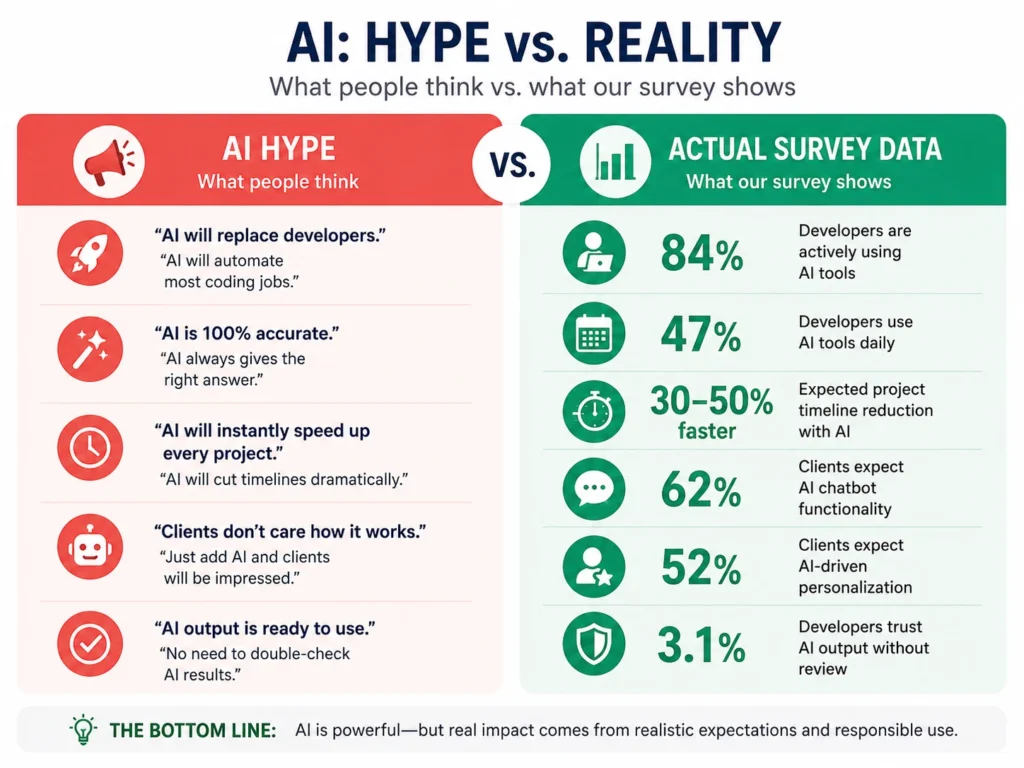
Survey data from developer communities and digital agency research reveals a clear picture of where client expectations currently stand:
| Survey Finding | Data |
|---|
| Developers actively using AI tools | 84% |
| Developers using AI daily | 47% |
| Clients expecting AI chatbot functionality | 62% |
| Clients expecting AI-driven personalization | 52% |
| Expected project timeline reduction | 30–50% faster |
| Developers who trust AI output without review | 3.1% |
Furthermore, the way clients research web development services has changed significantly. Commercial search queries now trigger AI-generated answers far more frequently than before. Consequently, clients arrive at agency conversations with AI-shaped opinions about timelines, pricing, and what is technically possible.
The numbers reveal something important. AI has not made web development easier to do well. Instead, it has raised the floor for basic execution while simultaneously raising the ceiling for what excellent work looks like.
Moreover, the gap between AI-assisted professional work and AI-generated templates is real and significant. However, clients do not always understand that gap yet. Therefore, agencies that communicate this difference clearly win better projects at appropriate prices.
The New Type of Client AI Has Created
The client who hires a web developer today is fundamentally different from the client of three or four years ago.
Back then, clients came to developers because they genuinely did not understand how websites worked. Today, many of them have a working theory — shaped by their own AI tool experiences.
They have seen AI generate a five-page website in under fifteen minutes. They follow design accounts and know what “above the fold” means. They have heard of Core Web Vitals. Furthermore, they have been pitched cheap “AI website” services from low-cost providers and developed a skepticism — but also a distorted price anchor.
This creates a client who is simultaneously more educated and more confused than any previous generation.
The Questions Clients Now Ask
The shift in client questions tells the whole story:
Before AI became mainstream:
- “Can you build this for us?”
- “How long will it take?”
- “What will it look like?”
After AI became mainstream:
- “How does your agency use AI?”
- “Why does this take weeks when AI builds sites in minutes?”
- “What results will this website actually deliver?”
Consequently, the discovery conversation has changed completely. Agencies that prepare for these questions win trust quickly. Agencies that get caught off guard by them lose credibility before the proposal stage.
7 Key Ways AI Is Changing Client Expectations
1. Clients Expect Significantly Faster Delivery
Speed expectations have shifted more dramatically than anything else in the client relationship.
Clients who have watched AI generate a website prototype in minutes now question timelines that previously went unchallenged. Furthermore, agencies that cannot explain the difference between AI template generation and strategically built, conversion-optimized websites lose proposals to competitors who can.
- Faster initial concepts and wireframes
- Compressed review and revision cycles
- Quicker time from approval to launch
- AI-assisted workflows that remove unnecessary delays
2. Personalization Is Now a Baseline Expectation
Personalization has moved from premium feature to standard client requirement. Survey data confirms that 52% of clients now expect AI-driven personalization as part of any serious web development project.
Clients in e-commerce, SaaS, healthcare, and education sectors specifically request:
- Dynamic content blocks that change based on visitor behavior
- AI-powered product recommendations that learn from browsing history
- Personalized landing pages for different audience segments
- Predictive search that anticipates user intent
Furthermore, clients expect these features integrated directly with their CRM systems and marketing automation platforms. Consequently, a developer who understands only front-end and back-end code is no longer meeting full market expectations.
3. AI Chatbots Have Become Standard Requirements
Not long ago, an intelligent chatbot felt like an impressive premium feature. Today, 62% of clients expect chatbot functionality as a baseline requirement on any professionally built website.
Modern clients expect chatbots that can:
- Answer customer questions without human involvement
- Qualify leads automatically through conversation
- Book appointments and handle scheduling requests
- Provide round-the-clock customer support
Moreover, automation expectations extend well beyond chat functionality. Clients want AI-powered contact forms that qualify leads. They want smart email triggers based on user behavior. They expect CRM updates that happen automatically without manual data entry.
4. Every Design Decision Needs Data Backing It
The era of presenting a design based on personal aesthetic judgment is over.
Survey results confirm that businesses now expect every UX decision to be backed by AI-driven data and real user behavior insights — not agency opinion. Furthermore, this expectation applies from the initial wireframe stage through post-launch optimization.
What clients now consider standard deliverables:
- Heatmap analysis showing click and scroll behavior
- Session recordings identifying drop-off points
- A/B testing results proving which design variant converts better
- Core Web Vitals scores demonstrating technical performance quality
- Conversion rate data showing actual business impact
Consequently, agencies that present data alongside design decisions build trust faster than those relying on creative instinct alone. Moreover, post-launch reporting has moved from optional extra to expected standard deliverable.
5. Performance Standards Have Risen Significantly
Page speed and technical performance expectations have increased because clients now understand that performance directly affects both search rankings and revenue.
Clients in web meetings now reference Core Web Vitals, LCP, and page speed scores — concepts that were developer-only knowledge just a few years ago. Furthermore, AI-powered performance monitoring tools have made these metrics visible to non-technical stakeholders, raising expectations about what normal performance looks like.
What clients now expect from performance:
- Mobile pages loading in under two seconds
- Green Core Web Vitals scores across all metrics
- Automatic performance monitoring — not periodic manual checks
- SEO performance that adapts to algorithm updates without emergency fixes
6. Security and Compliance Expectations Have Grown
Security awareness among clients has grown significantly as AI integration in websites has expanded potential vulnerabilities.
Clients now arrive at discovery calls asking specific questions about:
- AI-driven security monitoring that detects threats automatically
- Automated vulnerability scanning rather than periodic manual audits
- Data privacy compliance with applicable regional regulations
- Transparent AI data handling — what gets collected and how it gets used
Furthermore, ethical AI usage has entered the standard client conversation. Businesses want confirmation that AI features on their website handle user data responsibly and transparently. Consequently, agencies that communicate responsible AI implementation gain a clear trust advantage over those who only demonstrate technical features.
7. Clients Want Strategic Partners — Not Just Builders
This is the most significant finding across all survey data.
The client question has fundamentally changed:
Before: “Can you build this?” Now: “How can AI improve this?”
Businesses now expect developers to arrive at meetings with AI-driven strategies — not just technical execution plans. Furthermore, they want consultative guidance on where automation adds value, where personalization improves conversion, and how website infrastructure supports long-term business growth.
Consequently, web development has evolved from a technical execution service into a strategic partnership. Agencies that understand this shift win more projects at higher values. Those that do not are losing proposals to competitors who already made the transition.
Data vs Reality: What AI Actually Does in Web Development
The conversation around AI in web development involves significant hype. The survey data provides a more balanced picture:
| What It Feels Like | What the Data Actually Says |
|---|
| AI is replacing developers | 84% use AI as a tool — not as a replacement |
| Anyone can build a website with AI | Only 3.1% of developers trust AI output without human review |
| Timelines have collapsed completely | Projects become 30–50% faster — not 90% faster |
| AI handles strategy and architecture | Developers still own strategic decisions and quality control |
| Clients understand AI limitations | Most clients significantly overestimate AI capabilities |
Furthermore, the most important data point for agencies is this — the developers who use AI most effectively are not the ones doing less work. They are the ones doing better work in less time. Moreover, that quality difference is exactly what separates professional agency output from AI-generated templates.
How Agencies Must Adapt Right Now
Step 1: Reposition as an AI-Enabled Digital Partner
The agencies winning new business have made one fundamental positioning shift. They no longer describe themselves as website builders. They present themselves as AI-enabled digital partners who use technology strategically to drive measurable business outcomes.
This is not just marketing language. It reflects a genuine change in the service being delivered. Furthermore, clients who see this positioning immediately understand the value difference between professional AI-assisted work and a DIY AI template.
Step 2: Integrate AI Across Every Workflow Stage
Effective AI integration means using tools across the entire project lifecycle — not just in the design phase:
- Discovery: AI-assisted competitive analysis and audience research
- Design: AI-generated wireframe suggestions with human creative direction
- Development: AI code completion with developer review and quality control
- Content: AI-assisted copy generation with editorial refinement
- Testing: Automated performance and accessibility auditing
- Post-launch: AI-driven monitoring and continuous optimization reporting
Moreover, documenting how AI improves each stage helps clients understand what they are paying for — and why it costs more than a DIY AI template.
Step 3: Communicate What Human Expertise Adds
The most important conversation any agency must have with AI-informed clients addresses what human expertise provides that AI cannot replace.
Business strategy. Conversion thinking. Brand alignment. Quality control. Long-term relationship. These elements turn an AI-generated layout into a website that actually grows a business. Furthermore, clients who understand this distinction pay appropriately for professional work rather than comparing agency quotes to DIY tool costs.
Key Takeaways for Developers and Agencies
Here is what every developer and agency needs to take from these survey findings:
Speed is permanent — Clients will not return to accepting long timelines. Integrate AI tools to deliver faster without sacrificing strategic quality.
Personalization is now standard — 52% of clients expect it. Build this capability into your service offering or partner with specialists who have it.
Chatbots are baseline — 62% expect them. Know how to implement and configure AI chat solutions as part of standard project packages.
Data justifies every decision — Present heatmaps, performance metrics, and conversion data alongside design work. Evidence builds client trust faster than opinion.
Strategy wins over execution — Position as an AI-enabled strategic partner. Clients who see this value do not compare you to a monthly website builder subscription.
Conclusion
AI has already changed what clients expect from web development agencies. This shift is not approaching — it has happened. Furthermore, client expectations will continue evolving as AI tools become more capable and more widely used by non-technical business owners.
Agencies that adapt now — integrating AI tools, repositioning as strategic partners, and communicating value clearly — will win more business at better prices. Moreover, they will retain clients longer because they deliver outcomes that matter, not just websites that look good.
Those that resist this shift will find themselves losing proposals to competitors who moved faster and positioned smarter.
Therefore, the question is not whether to adapt. The question is how quickly you will start — and how clearly you will communicate the difference between AI-assisted professional expertise and the AI templates clients can build themselves.
Frequently Asked Questions (FAQs)