
Millions of blog posts get published every single day. Furthermore, the vast majority of them never rank on the first page of Google, regardless of how genuinely well-written or helpful the content actually is.
Consequently, the gap between content that ranks and content that disappears rarely comes down to writing talent alone. It comes down to whether the post is genuinely structured, formatted, and optimized in ways search engines can understand — while still reading naturally for the actual human being who lands on the page.
Furthermore, writing an SEO-friendly blog post is not about stuffing keywords into every sentence or gaming an algorithm. It is about combining genuine reader value with the specific technical and structural signals that help search engines recognize that value and serve it to the right searchers.
In this guide, we walk through exactly how to write blog posts that satisfy both requirements simultaneously — genuinely helpful for readers, and genuinely optimized for search visibility. Furthermore, every practice covered here reflects what actually moves rankings, not outdated tactics that stopped working years ago.
Set up your technical SEO foundation first. Read: How to Install and Set Up Rank Math SEO
Reasons Why You Should Choose WordPress for Your Website
Step 1: Choose a Focus Keyword Based on Genuine Search Intent
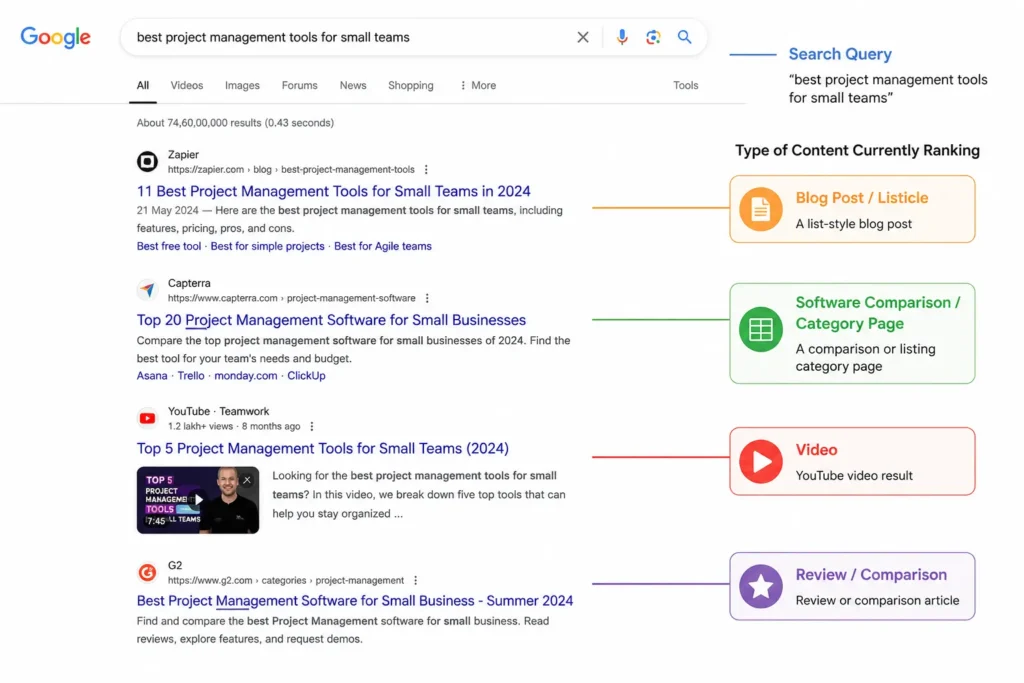
Furthermore, before writing a single sentence, identify the specific keyword your post should target — and just as importantly, understand what searchers genuinely want when they type that phrase.
Furthermore, search intent generally falls into four categories. Informational intent means the searcher wants to learn something, like “how to write a blog post.” Navigational intent means they want a specific website. Commercial intent means they are comparing options before deciding. Transactional intent means they are ready to act immediately.
Consequently, search “your keyword” yourself before writing and study what currently ranks. If list-style articles dominate the results, a single long-form guide without headers may struggle regardless of quality. Furthermore, if how-to guides dominate, a listicle format may underperform even with genuinely better information inside it.
Furthermore, extremely broad, high-volume keywords are genuinely difficult for newer or smaller websites to rank for against established competitors. Consequently, targeting more specific, longer-tail keyword phrases — which carry lower search volume but also lower competition — often produces faster, more achievable ranking results.
Step 2: Structure Your Post Around Clear, Scannable Headings
Furthermore, search engines and readers both rely heavily on heading structure to understand what a page covers and how it is organized.
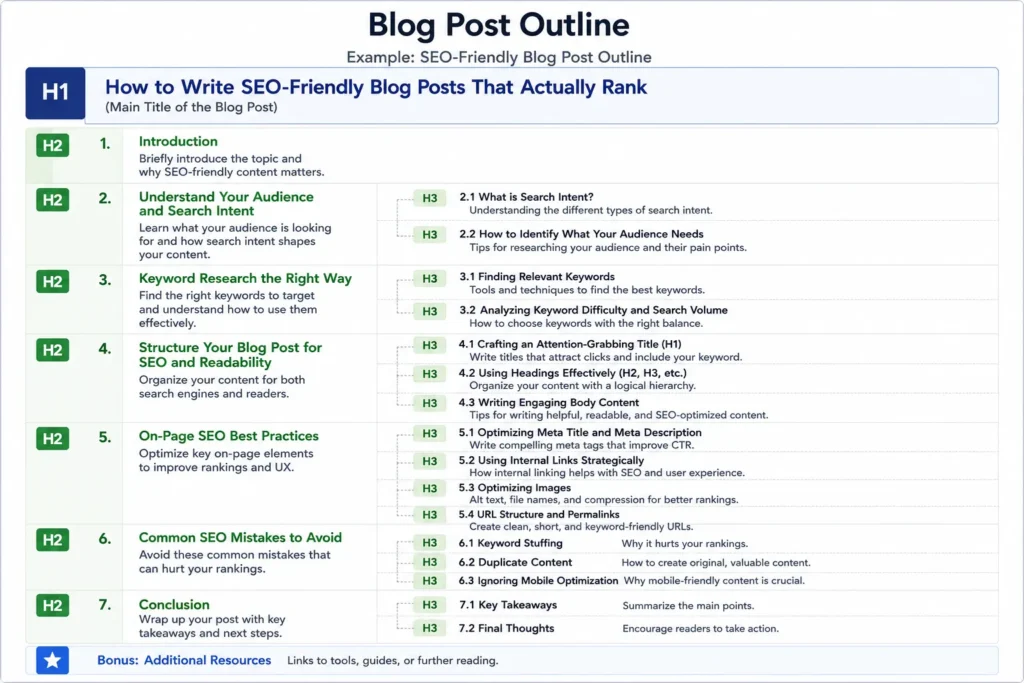
Furthermore, your post title should be the only H1 on the page, clearly stating what the post covers. Every major section beneath it should use H2 headings, with H3 subheadings breaking down more detailed points within each section. Consequently, this hierarchy helps search engines understand your content’s structure while helping readers scan quickly to the specific section they need.
Furthermore, sections stretching beyond 300 words without a subheading become genuinely difficult to scan, both for readers and for the SEO analysis tools most content teams use. Consequently, breaking longer sections into logical, appropriately labeled subsections improves both readability scores and genuine reader experience.
Furthermore, vague, clever headings that do not clearly indicate what follows frustrate scanning readers and provide search engines with less useful context. Consequently, clear, descriptive headings — even if slightly less creative — consistently outperform cleverness for genuine SEO and usability purposes.
Step 3: Write for Readability, Not Just Keyword Placement
Furthermore, readability directly affects how long visitors stay on your page, and search engines increasingly factor genuine user engagement signals into rankings.
Furthermore, paragraphs longer than four or five lines become visually intimidating, particularly on mobile screens where most readers now encounter your content. Consequently, breaking your writing into short, focused paragraphs — each covering one clear idea — keeps readers moving through your content rather than abandoning it partway.
Furthermore, starting multiple consecutive sentences with the same word creates a repetitive, mechanical reading rhythm that both readers and readability analysis tools flag as a quality issue. Consequently, deliberately varying how each sentence begins throughout your post improves genuine reading flow.
Furthermore, words like “furthermore,” “however,” “consequently,” and “moreover” help readers understand how ideas connect to each other logically. Consequently, aim for transition words appearing in roughly 30 percent or more of your sentences, which most SEO analysis tools specifically measure as a readability signal.
See these exact principles applied throughout a real optimization project. Read: How to Install and Set Up Rank Math SEO
Step 4: Optimize Your Title Tag and Meta Description
Furthermore, your title tag and meta description do not directly boost rankings on their own, but they genuinely determine whether searchers click your result once it appears.
Furthermore, your title tag should stay under roughly 60 characters to avoid being cut off in search results, while including your focus keyword as naturally and prominently as possible. Consequently, front-loading the keyword near the beginning of the title, where practical, often improves visibility and relevance signals simultaneously.
Furthermore, your meta description should summarize the genuine value of your post within roughly 150-160 characters, giving searchers a clear, honest reason to click your result over a competing one. Consequently, avoid vague, generic descriptions that could apply to any article on the topic — specificity genuinely improves click-through rates.
Step 5: Use Internal Linking Strategically
Furthermore, internal links help search engines understand your site’s content relationships while keeping readers engaged with more of your content beyond a single page.
Furthermore, as you write, identify genuine opportunities to link to related posts already published on your site — a mention of a specific tool, technique, or related topic naturally deserves a link where relevant content already exists. Consequently, avoid forcing links where they do not genuinely fit; irrelevant internal links confuse readers and dilute their genuine value.
Furthermore, after publishing a new post, revisit relevant older posts and add links pointing to the new content where genuinely appropriate. Consequently, this practice helps search engines discover and index new content faster while distributing ranking authority across your site more effectively.
Step 6: Optimize Images for Both SEO and Speed
Furthermore, images make content more engaging, but unoptimized images are also one of the most common causes of slow-loading blog posts that hurt both user experience and rankings.
Furthermore, every image should include alt text that genuinely describes what the image shows, incorporating your keyword naturally only where it authentically fits — never forced awkwardly for SEO purposes alone. Consequently, this practice improves accessibility for visually impaired readers while giving search engines additional context about your content.
Furthermore, large, uncompressed image files slow down page loading significantly, directly affecting both search rankings and reader patience. Consequently, compressing images before uploading — without visibly sacrificing quality — protects your page speed as your content library grows.
Comprehensive image and site speed optimization strategies. Read: 12 Best Speed Optimization Tips for Your WooCommerce Store
Step 7: Avoid the SEO Writing Mistakes That Undo Everything Else
Furthermore, even well-researched, well-structured posts can underperform when they fall into a handful of common, avoidable traps.
Furthermore, repeating your focus keyword unnaturally throughout the text makes content genuinely difficult to read and can trigger search engine penalties rather than rewards. Consequently, use your keyword naturally where it fits, and rely on synonyms and related phrases elsewhere.
Furthermore, publishing multiple pages covering nearly identical ground confuses search engines about which page deserves to rank, often resulting in neither page performing well. Consequently, ensure every published post covers genuinely distinct ground or targets a meaningfully different angle.
Furthermore, since most readers now encounter your content on mobile devices, testing how your post actually looks and reads on a smartphone — not just reviewing it in a desktop editor — catches formatting issues before publication rather than after.
Step 8: Structure Content to Win Featured Snippets
Furthermore, featured snippets — the highlighted answer box appearing above standard search results — capture significantly more clicks than the standard first-position listing beneath them.
Furthermore, Google typically pulls featured snippets from content that answers a specific question clearly and concisely near the beginning of a section, rather than building up to the answer gradually. Consequently, structuring a subheading as a direct question, then answering it plainly in the following one or two sentences, genuinely increases your odds of snippet selection.
Furthermore, Google frequently pulls numbered list snippets for “how to” queries and table snippets for comparison queries specifically. Consequently, formatting step-by-step instructions as genuine numbered lists, and comparative data as genuine tables rather than paragraph text, aligns your content with the exact formats Google’s snippet algorithm favors.
Furthermore, Google typically displays snippets between 40 and 60 words for paragraph-style answers. Consequently, including one tightly written, self-contained answer within a longer, more detailed section lets you satisfy both the snippet algorithm and readers wanting deeper context immediately afterward.
Step 9: Build E-E-A-T Signals Into Your Content
Furthermore, Google’s quality guidelines specifically evaluate Experience, Expertise, Authoritativeness, and Trustworthiness — commonly abbreviated as E-E-A-T — when assessing whether content deserves to rank, particularly for topics affecting health, finance, or genuine safety.
Furthermore, content that reflects actual first-hand experience — original examples, specific results, or genuine testing — increasingly outperforms generic, secondhand summaries of a topic. Consequently, wherever genuinely possible, include specific details, original data, or concrete examples that demonstrate you have actually done what you are writing about, not just researched it.
Furthermore, including a visible author byline with relevant credentials or experience builds genuine trust signals for both readers and search engines evaluating expertise. Consequently, even a brief author bio explaining relevant background adds meaningful credibility that anonymous, uncredited content cannot match.
Furthermore, linking to authoritative, credible sources when citing statistics or specific claims demonstrates genuine research rigor rather than unsupported assertion. Consequently, this practice builds trustworthiness while also giving readers a path to verify information independently if they choose to.
Furthermore, displaying when content was published, and genuinely updating it when information changes, signals ongoing editorial care rather than a one-time, abandoned publication. Consequently, this transparency matters increasingly for topics where accuracy can shift over time.
Step 10: Refresh and Update Existing Content Regularly
Furthermore, publishing new content matters, but systematically refreshing existing posts often delivers stronger ranking returns for considerably less effort than starting from scratch every time.
Furthermore, regularly reviewing your Google Search Console data reveals which published posts have lost ranking positions or traffic over time. Consequently, prioritizing updates for posts that were previously performing well, but have since declined, often recovers rankings faster than investing equivalent effort into an entirely new post.
Furthermore, content referencing outdated statistics, discontinued tools, or visibly dated screenshots signals staleness to both readers and search engines evaluating content freshness. Consequently, a scheduled quarterly or biannual review process, checking for exactly these details, keeps your content library genuinely current without requiring a complete rewrite.
Furthermore, sections that felt adequate when first published sometimes look genuinely thin compared to how comprehensively competing content now covers the same subtopic. Consequently, identifying and expanding these specific thin sections, rather than padding the entire post uniformly, improves genuine comprehensiveness efficiently.
Furthermore, publishing multiple posts covering nearly identical ground over time can create keyword cannibalization, where your own pages compete against each other for the same search rankings. Consequently, consolidating overlapping content into one genuinely comprehensive, authoritative post — then redirecting the older, thinner versions — often improves rankings for the surviving page significantly.
Step 11: Match Content Length to Genuine Topic Complexity
Furthermore, chasing an arbitrary word count target regardless of topic complexity produces either padded, diluted content or artificially truncated coverage that fails to genuinely satisfy search intent.
Furthermore, before committing to a specific length, review the content currently ranking on page one for your target keyword. Consequently, if top-ranking pages average 2,000 words with genuinely comprehensive coverage, a 600-word post likely cannot compete regardless of writing quality — the topic itself demands greater depth.
Furthermore, adding filler content simply to reach a target word count dilutes genuine value and increases bounce rate as readers recognize padding immediately. Consequently, every section should earn its place by adding genuine, non-redundant value rather than existing purely to extend length.
Furthermore, some search intents — quick definitions, simple yes-or-no questions, straightforward conversions — are genuinely better served by concise, direct answers than by unnecessarily expanded long-form content. Consequently, matching length to what searchers actually need, rather than defaulting to maximum length for every topic, produces better engagement and ranking outcomes.
Quick Reference: SEO Blog Writing Checklist
| Step | Key Action |
|---|---|
| 1. Keyword Research | Match content format to genuine search intent |
| 2. Structure | One H1, logical H2/H3 hierarchy, short sections |
| 3. Readability | Short paragraphs, varied sentences, transition words |
| 4. Meta Tags | Keyword-inclusive title, compelling meta description |
| 5. Internal Linking | Link naturally to and from related content |
| 6. Image Optimization | Descriptive alt text, compressed file sizes |
| 7. Avoid Mistakes | No keyword stuffing, no duplicate content, mobile-tested |
Conclusion
Writing SEO-friendly blog posts that actually rank does not require choosing between what search engines want and what readers genuinely need — the two align far more often than most writers assume.
Furthermore, clear structure helps both search engines and skimming readers navigate your content. Short paragraphs and varied sentences improve both readability scores and genuine reading experience. Strategic internal linking helps both search discovery and reader engagement with more of your site. Consequently, every practice in this guide serves double duty, strengthening your SEO performance precisely by making your content genuinely better for the humans reading it.
Therefore, approach your next blog post with both audiences in mind simultaneously — write something genuinely worth reading, then structure and optimize it so search engines can recognize and reward that value. Consequently, that combination, applied consistently, is what actually moves content from buried on page five to genuinely ranking where readers can find it.
Frequently Asked Questions (FAQs)
How long should an SEO-friendly blog post be?
Furthermore, length should match what genuinely serves the topic and search intent rather than hitting an arbitrary word count. Comprehensive guides covering complex topics often perform well at 1,500-2,500 words, while simpler, direct-answer content may rank effectively at far shorter lengths. Consequently, prioritize thoroughness and genuine value over reaching a specific number.
How many times should I use my focus keyword in a blog post?
Furthermore, there is no fixed ideal number — natural, contextually appropriate usage matters far more than hitting a specific keyword density percentage. Consequently, use your keyword in the title, first paragraph, at least one heading, and naturally throughout the body wherever it genuinely fits, without forcing repetition that disrupts natural reading flow.
Does blog post readability actually affect SEO rankings?
Yes, indirectly but genuinely. Furthermore, readable content keeps visitors engaged longer, reduces bounce rate, and increases the likelihood of social shares and backlinks — all factors that search engines consider when evaluating content quality. Consequently, readability and SEO performance are genuinely connected rather than separate concerns.
Should I write for search engines or for readers first?
Furthermore, write for readers first, then apply SEO structure and optimization on top of genuinely valuable content. Content created purely to satisfy search algorithms, without genuine reader value, consistently underperforms over time as search engines have become increasingly sophisticated at recognizing content quality beyond surface-level keyword matching.
How soon after publishing should I expect a blog post to rank?
Furthermore, new content typically takes weeks to months to achieve meaningful ranking, depending on keyword competition, your site’s existing authority, and how quickly search engines crawl and index the new page. Consequently, submitting your sitemap to Google Search Console and building relevant internal links to new posts can help accelerate this discovery and ranking process.