
Furthermore, with so many sources of information available to customers and so many buying options, your customers might genuinely not wait for answers — they simply move on to a competitor who responds faster. Consequently, the businesses winning customer loyalty today are not necessarily the ones with the best products alone, but the ones that answer questions the instant they arise.
This is precisely where AI chatbots have changed the game entirely. Chatbots can help your customers and potential clients find or input information quickly by instantly responding to requests that use audio input, text input, or a combination of both — eliminating the need for human intervention or manual research. Furthermore, the latest AI chatbots, also known as intelligent virtual assistants, not only understand natural conversations thanks to advanced language models but also proactively automate various tasks. Gone are the days of “Press 6 to connect to customer service.”
In this guide, we explore exactly how AI chatbots are revolutionizing customer support — the genuine benefits customers experience, what businesses gain in return, and which industries benefit most from this shift.
Adding an AI chatbot to your own online store? Read: AI Chatbots for E-Commerce: The Future of WordPress E-Commerce
What Customers Genuinely Notice and Appreciate About Chatbots
Furthermore, your customers enjoy numerous benefits from AI chatbots, many of which also benefit your company in return. If you were to ask your customers directly what they notice and appreciate most, the following would likely top their list.
Fast Answers, Around the Clock
Furthermore, chatbots answer customer questions quickly, at any hour, without the waiting that traditional support channels require. Consequently, this immediacy alone addresses one of the most common sources of customer frustration.
Personalized Suggestions, Not Generic Responses
Furthermore, chatbots not only respond quickly but also anticipate customer needs, deliver useful messages, and recommend new products. AI analyzes customer interactions to provide recommendations and suggest genuinely relevant next steps, which directly increases customer satisfaction and lifetime value.
Meeting Customers Wherever They Already Are
Furthermore, conversational marketing can be deployed across a wide variety of platforms — web pages, mobile apps, telephone, in-store kiosks, social media, or SMS. Consequently, this omnichannel approach lets you connect with customers where they are most active and comfortable, rather than forcing them onto a single, inconvenient channel.
Speaking the Customer's Own Language
Furthermore, your customers can contact your chatbot from almost any country globally. Enterprise-grade chatbots support multiple languages and can even make an educated guess based on initial input, whether in chat, text, or voice — meaning your potential market genuinely becomes worldwide.
Self-Service on Their Own Terms
Furthermore, customers often prefer completing simple tasks independently rather than waiting for a human agent. Consequently, chatbots prompt customers with self-service options and resource directions, saving both customer time and reducing your staffing needs simultaneously.
Never Repeating Themselves
Furthermore, enterprise-grade chatbots record customer conversations and all relevant details. When a chat transfers to your customer service team, customers will not need to answer the same time-consuming questions again — reducing frustration significantly.
What Businesses Gain From Deploying AI Chatbots
Furthermore, AI chatbots respond quickly, accurately process natural human language, and automate personalized experiences — offering numerous benefits and genuinely new opportunities to your organization.
Stronger Engagement and Brand Loyalty
Furthermore, before chatbots, most customer queries, concerns, or complaints required a human touch. Now, chatbots eliminate prolonged wait times across phone, email, and live chat support, becoming instantly accessible to multiple users simultaneously and promptly addressing customer interests and concerns.
Reduced Operational Costs
Furthermore, chatbots present the genuine option to reduce 24×7 staffing expenses, or even eliminate after-hours staffing costs entirely, provided your chatbots can effectively handle most incoming questions. Consequently, you optimize processes that previously relied entirely on human interaction.
Higher Quality Human Service Where It Matters Most
Furthermore, customer service staff can genuinely lose enthusiasm when they spend excessive time answering repetitive queries. By employing chatbots to handle routine questions and passing conversations over when more insight is genuinely needed, you engage your staff when creativity and initiative matter most — making their work more rewarding and their responses more thoughtful.
More Sales Through Faster, Smarter Guidance
Furthermore, AI-powered chatbots generate leads, encourage conversions, and cross-sell effectively. Website visitors inquiring about features or plans get faster responses that guide them toward purchase decisions. Moreover, for complex, multi-step sales funnels, chatbots can ask qualification questions and connect customers directly with trained sales agents, lifting overall conversion rates.
Scale Without Proportionally Scaling Headcount
Furthermore, chatbots operate without the time and energy restrictions humans face, answering questions from customers worldwide at any hour. Consequently, as your customer base grows, chatbot implementation accommodates increased interactions without incurring the rising costs or staffing needs that growth traditionally demands.
Practical implementation guide for adding chatbots to your store. Read: AI Chatbots for E-Commerce: The Future of WordPress E-Commerce
Genuine Customer Data, Captured Naturally
Furthermore, the first customer interaction with your chatbot allows it to request customer information, directly generating leads for your marketing team. These same questions can prequalify customers before transferring them to sales, letting salespeople determine goals and strategy immediately.
Insights Without Depending on Cookies
Furthermore, machine-learning chatbots collect valuable customer relationship management data — feedback, preferences, interaction behavior, contact details — all without relying on cookies. Consequently, this data refines marketing campaigns and personalizes messaging as third-party cookie tracking continues declining in reliability.
Consistent Messaging Across Every Interaction
Furthermore, chatbots provide consistent information and messaging, ensuring every customer receives the same quality of service. This consistency, derived directly from your knowledge base, maintains brand integrity — without it, different human agents might mistakenly give conflicting directions to different customers.
Composure That Human Agents Cannot Always Maintain
Furthermore, anyone can have a bad day, which might cause customer service agents to react in ways they later regret. Customer service calls also often begin with customers venting frustration from a prior experience. Consequently, a composed chatbot absorbs most of that initial frustration, meaning by the time a live agent takes over, much of the anger has already dissipated.
How Different Industries Benefit From AI Chatbots
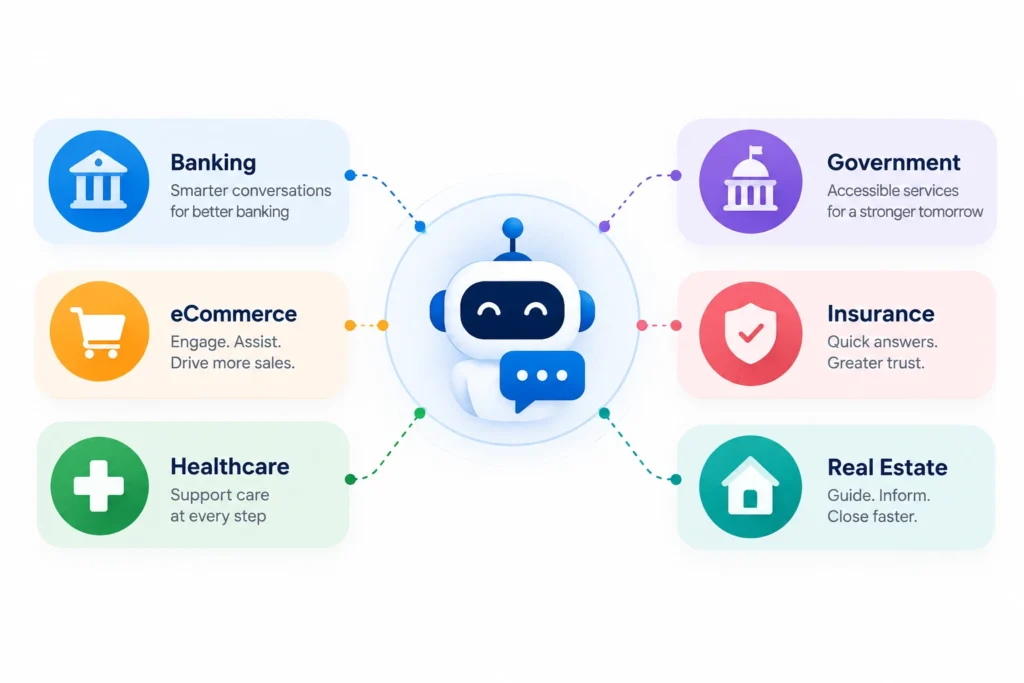
Furthermore, chatbots genuinely benefit every industry, but several sectors show particularly strong, standout use cases.
Banking and Financial Services
Furthermore, in a genuinely transactional industry, AI-powered chatbots deliver fast and accurate answers, eliminate waiting times, streamline information searches, and facilitate meaningful customer interactions around account questions and transactions.
E-Commerce and Online Retail
Furthermore, chatbots empower customers to self-serve, accurately route complex queries to human agents, and deliver highly personalized, contextually relevant shopping experiences that directly support conversion.
Healthcare
Furthermore, chatbots empower patients and streamline their experience through intelligent automation — assisting skilled medical professionals while enabling patients to quickly handle appointment booking, prescription refills, and medication reminders.
Government Services
Furthermore, chatbots empower citizens to access basic information about paying bills and upcoming events, providing efficient, accurate responses that elevate user experience while saving costs and delivering rapid return on investment.
Insurance
Furthermore, customers seek real-time, personalized, and accurate responses whether requesting quotes, filing claims, or making payments. Providing fast, accurate answers here helps build long-term customer relationships in a genuinely trust-dependent industry.
Real Estate
Furthermore, chatbots swiftly gather requirements to create buyer profiles, answer property availability questions, and schedule appointments — inquiring about client preferences during profile creation to foster deeper, more relevant relationships.
Beyond Customer Service: HR and Internal Operations
Furthermore, in organizations, HR departments often struggle to efficiently manage routine tasks, repeatedly addressing employees’ frequently asked questions. This drains HR personnel of time and energy that could otherwise go toward recruitment, retention, leadership development, and shaping company culture.
Consequently, natural language processing and machine learning HR chatbots understand, communicate, and automate various tasks supporting both candidates and existing employees — including onboarding, answering FAQs, handling time-off requests, and checking remaining leave balances. Moreover, this application demonstrates that AI chatbot benefits extend genuinely beyond customer-facing support into internal operational efficiency as well.
Quick Reference: 20 Benefits of AI Chatbots at a Glance
| For Customers | For Your Business |
|---|---|
| Fast, instant answers | Improved engagement and brand loyalty |
| Personalized recommendations | Reduced operational costs |
| Omnichannel accessibility | Higher quality human service |
| Multi-language support | Increased sales and conversions |
| Self-service options | Scalability without proportional cost |
| 24×7 availability | Direct customer data capture |
| No repeated information needed | Cookie-free customer insights |
| — | Consistent brand messaging |
| — | Composed handling of frustration |
| — | Improved HR operations |
Conclusion
AI chatbots have genuinely transformed customer support from a source of frustration into a competitive advantage — for customers who no longer wait, and for businesses who no longer need to choose between service quality and operational cost.
Furthermore, the benefits compound across every stakeholder simultaneously. Customers get fast, personalized, always-available support in their own language, on their preferred channel. Businesses gain reduced costs, increased sales, richer customer data, and more engaged, less burned-out support teams. Moreover, industries from banking to healthcare to real estate each find genuinely distinct, valuable applications for this same underlying technology.
Therefore, the question for most businesses is no longer whether AI chatbots genuinely work — the evidence across every industry confirms they do. Consequently, the real question is how thoughtfully you implement one, ensuring it complements your human team rather than replacing the genuine judgment and empathy only people can provide for your most complex customer needs.
Frequently Asked Questions (FAQs)
Do AI chatbots genuinely improve customer satisfaction, or just reduce costs?
Both, genuinely simultaneously. Furthermore, chatbots improve customer satisfaction through instant, 24/7 responses and personalized recommendations, while also reducing operational costs by handling routine queries without requiring proportional staffing increases. Consequently, businesses that implement chatbots thoughtfully see improvements in both customer experience metrics and operational efficiency together.
Which industries benefit most from AI chatbot implementation?
Banking, e-commerce, healthcare, government services, insurance, and real estate all show particularly strong use cases. Furthermore, transactional industries where customers need fast, accurate answers around account status, availability, or scheduling benefit especially significantly from chatbot implementation.
Can AI chatbots handle complex customer issues, or only simple questions?
AI chatbots excel at handling routine, repetitive questions and initial qualification, while genuinely complex issues get transferred to human agents with full conversation context already captured. Furthermore, this handoff process means customers never need to repeat information already provided to the chatbot, creating a smoother experience across the entire support journey.
How do AI chatbots collect customer data without relying on cookies?
Machine-learning chatbots gather customer relationship management data directly through conversation — preferences, feedback, contact details, and interaction behavior — collected as a natural byproduct of genuine customer interaction rather than through tracking technology. Consequently, this approach provides valuable insight even as third-party cookie tracking becomes increasingly unreliable.
Are AI chatbots useful for internal business operations, not just customer support?
Yes, genuinely. Furthermore, HR departments specifically benefit from chatbots handling employee FAQs, onboarding processes, time-off requests, and leave balance inquiries — freeing HR personnel to focus on higher-value work like recruitment and culture-building rather than repetitive administrative questions.