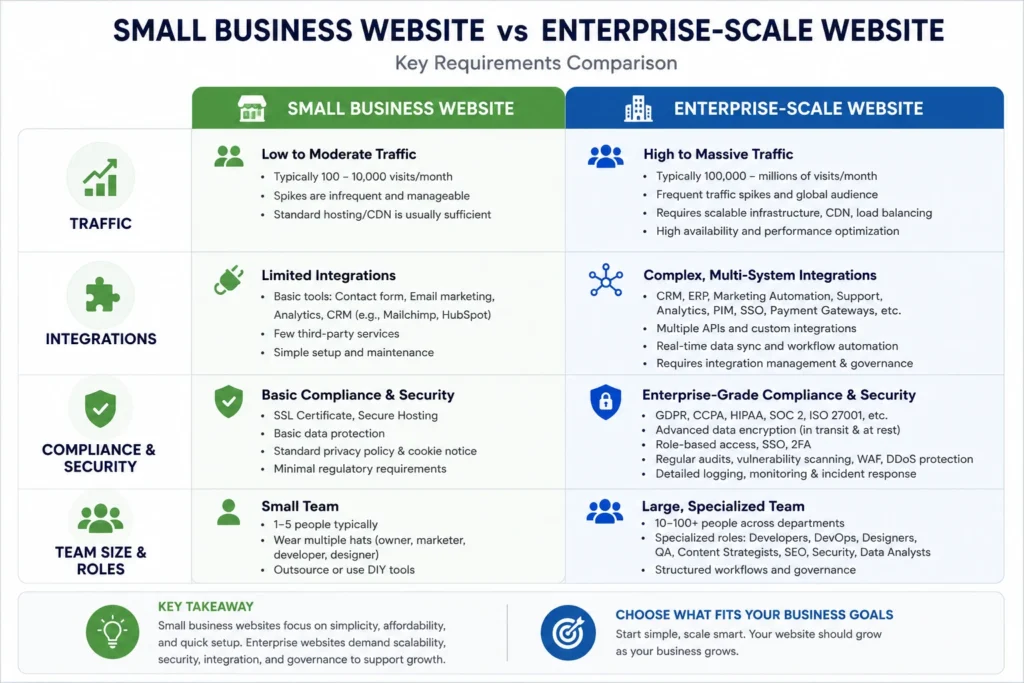
Selecting a WordPress agency for a five-page business website and selecting one for a large enterprise organization are genuinely different exercises, despite both technically involving the same underlying CMS.
Furthermore, an enterprise WordPress build must integrate with existing CRM systems, marketing automation platforms, and internal software already embedded across your organization. Moreover, it must handle significant traffic volume reliably, meet stringent security and compliance standards, and support a content team far larger than a typical small business ever manages. Consequently, choosing the wrong partner at this scale costs far more than a disappointing small business website ever would — in lost revenue, security exposure, and months of costly rework.
With many agencies claiming enterprise capability, finding the one that genuinely aligns with your organization’s specific needs requires careful, deliberate evaluation. Furthermore, the right questions reveal genuine capability far more reliably than a polished sales pitch or an impressive-looking portfolio alone.
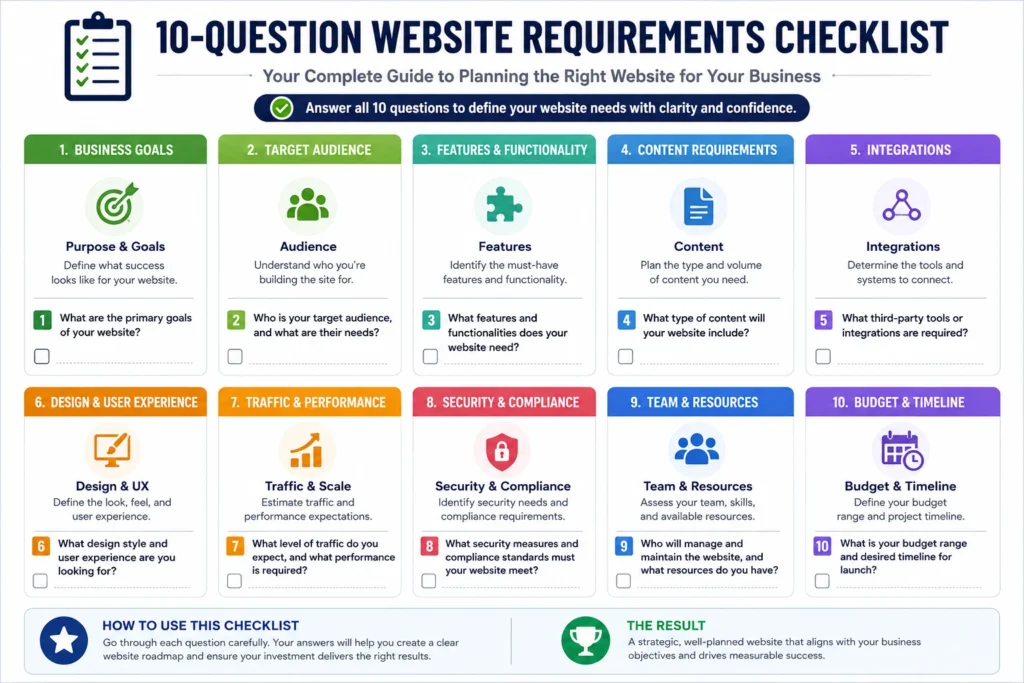
In this guide, we walk through the 10 must-ask questions that separate agencies genuinely equipped for enterprise WordPress work from those simply claiming the capability. Furthermore, each question includes what a strong answer sounds like — and what should raise concern.
Why Enterprise WordPress Selection Deserves Extra Scrutiny
The Stakes Are Genuinely Higher
Furthermore, an enterprise website typically serves as a critical business asset — driving revenue, supporting brand reputation at scale, and often integrating deeply with systems that other departments depend on daily. Consequently, a poorly executed enterprise WordPress project does not just produce a disappointing website; it can disrupt operations, expose sensitive data, or damage credibility with customers and stakeholders simultaneously.
Portfolio Screenshots Are Not Enough
Furthermore, at enterprise scale, evaluating a potential partner requires going meaningfully deeper than reviewing pretty screenshots. Consequently, the questions in this guide are designed specifically to surface the operational, technical, and organizational capability that determines whether a partnership actually succeeds once real complexity enters the picture.
Why Choosing the Right WordPress Partner Matters
Question 1: What Is Your Experience Specifically With Enterprise Website Builds?
Furthermore, a crucial factor when selecting an enterprise WordPress agency is genuine experience with enterprise-level development specifically — not general WordPress familiarity. Look for agencies with a proven track record delivering the outcomes large organizations genuinely need — growth, performance, and robust security working together.
Furthermore, evaluate their portfolio with particular attention to projects similar to your industry and scale. Moreover, ask specifically about their experience integrating WordPress with CRM systems, marketing automation tools, eCommerce platforms, and any other enterprise software already in your technology stack. Consequently, an agency without concrete answers here likely lacks the genuine enterprise experience their marketing materials claim.
Question 2: Can You Show Verified Case Studies With Measurable Outcomes?
Furthermore, request specific examples of successful enterprise WordPress projects the agency has genuinely completed — not generic portfolio pieces, but documented case studies with measurable outcomes and verifiable client testimonials.
Furthermore, pay particular attention to how the agency discusses brand translation — since your website is an extension of your brand, the agency must demonstrate genuine understanding of how to translate your brand’s essence into visually consistent, effective design. Consequently, vague case studies without specific metrics or client references deserve additional scrutiny before proceeding.
Question 3: What Is Your Process for Responsive, User-Friendly Design at Scale?
Furthermore, user experience is genuinely paramount for any enterprise website, involving intuitive navigation, easy-to-use interfaces, and thorough usability optimization across your entire, often complex, site structure.
Furthermore, a reputable agency maintains a comprehensive, documented method for optimizing websites across different devices, resolutions, and screen sizes — providing a genuinely optimal experience across every platform your diverse audience uses. Consequently, ask them to walk through their actual UX research and testing process rather than accepting a generic assurance that “we do responsive design.”
Question 4: How Do You Approach Security and Data Protection?
Furthermore, data breaches and cyberattacks represent significant, genuine concerns for organizations operating at enterprise scale, making website security and data protection an absolute top priority in any partner evaluation.
Furthermore, ask specifically about their security measures — SSL certificates, regular automated backups, and robust firewall configurations. Moreover, inquire about their disaster recovery plan specifically, ensuring your website’s data stays genuinely secure and can be restored quickly following any unforeseen incident. Consequently, an agency that cannot articulate a clear disaster recovery process has not genuinely operated at enterprise scale before.
Question 5: What Ongoing Support and Maintenance Do You Provide?
Furthermore, as a large enterprise, your website needs genuine scalability and the capacity to handle significant traffic volume reliably, even during peak demand periods your team may not fully anticipate.
Furthermore, understand the agency’s process for handling updates, applying security patches, and resolving issues that arise after launch. Consequently, a reliable partner offers a comprehensive, clearly documented support package that ensures your website’s continuous performance and long-term reliability — not a vague promise to “be available if something comes up.”
Question 6: How Do You Handle Multi-Team, Multi-Stakeholder Content Workflows?
Furthermore, enterprise organizations typically involve multiple departments, content contributors, and approval layers — a genuinely different workflow challenge than a small business with one or two content editors.
Furthermore, ask specifically how the agency configures user roles, content approval workflows, and permission structures to prevent unauthorized changes while still allowing legitimate teams to work efficiently. Consequently, an agency with genuine enterprise experience should discuss WordPress’s role management capabilities confidently and specifically, not generically.
Question 7: What Is Your Approach to Multisite or Multi-Brand Architecture?
Furthermore, many enterprise organizations operate multiple brands, regional websites, or departmental sub-sites that need to share infrastructure while maintaining distinct identities.
Furthermore, ask whether the agency has genuine experience with WordPress Multisite architecture, and how they would structure your specific situation if multiple properties are involved. Consequently, this question quickly reveals whether an agency has handled organizational complexity beyond a single standalone website.
Question 8: How Do You Handle Compliance Requirements Specific to Our Industry?
Furthermore, industries like finance, healthcare, and education carry specific regulatory and compliance requirements that a genuinely experienced enterprise agency should already understand.
Furthermore, ask directly whether they have worked within your specific industry’s compliance framework — data privacy regulations, accessibility standards, or sector-specific requirements. Consequently, an agency unfamiliar with your industry’s compliance landscape introduces genuine risk that becomes expensive to correct after launch rather than before.
Question 9: What Does Your Migration Process Look Like If We Are Moving From Another Platform?
Furthermore, many enterprise WordPress projects involve migrating from a legacy CMS or a different platform entirely — a genuinely complex process where SEO rankings and content integrity are both at meaningful risk.
Furthermore, ask specifically how they handle URL mapping, 301 redirects, and content migration at scale, along with how they protect existing search rankings throughout the transition. Consequently, an agency without a clear, methodical migration process risks costing you significant organic traffic during and after the switch.
Question 10: How Do You Structure Pricing and Scope for Enterprise Projects?
Furthermore, enterprise projects involve genuinely more moving parts than small business builds, making transparent, detailed pricing structure essential before any contract gets signed.
Furthermore, request a genuinely detailed, phase-by-phase cost breakdown — discovery, design, development, integration, testing, and ongoing support — rather than accepting a single lump-sum figure that obscures where your budget actually goes. Consequently, transparent pricing structure at this stage prevents the scope disputes and budget overruns that derail enterprise projects far too often.
Enterprise WordPress Agency Evaluation Checklist
Use this quick reference to evaluate any potential enterprise WordPress partner:
| Category | Key Question |
|---|
| Experience | Proven enterprise-scale project history in your industry? |
| Evidence | Verified case studies with measurable, documented outcomes? |
| UX Process | Documented responsive design and testing methodology? |
| Security | Clear SSL, backup, firewall, and disaster recovery protocols? |
| Support | Comprehensive, documented ongoing maintenance package? |
| Workflow | Genuine multi-team content and permission management experience? |
| Architecture | Real WordPress Multisite or multi-brand experience? |
| Compliance | Familiarity with your specific industry’s regulatory requirements? |
| Migration | Methodical process protecting SEO during platform transitions? |
| Pricing | Transpar |
Red Flags That Signal an Agency Is Not Genuinely Enterprise-Ready
🚩 Vague answers about integration experience — Furthermore, if an agency cannot speak specifically about CRM, marketing automation, or eCommerce platform integrations, their enterprise claims likely exceed their actual experience.
🚩 No documented security or disaster recovery process — Furthermore, security should never be an afterthought discussed only when directly asked; genuine enterprise agencies lead with this information proactively.
🚩 Reluctance to provide verifiable client references — Furthermore, established enterprise agencies confidently connect you with past clients; hesitation here often signals limited genuine enterprise track record.
🚩 A single lump-sum quote without phase breakdown — Furthermore, enterprise projects involve genuine complexity that transparent pricing should reflect clearly, not obscure behind one large number.
🚩 No clear point of contact or account management structure — Furthermore, enterprise partnerships require ongoing, structured communication; an agency without clear account management processes struggles to maintain this over a multi-month or multi-year relationship.
Conclusion
Choosing an enterprise WordPress agency is a genuinely consequential decision — one that affects security, scalability, brand consistency, and operational efficiency across your entire organization for years afterward.
Furthermore, the ten questions in this guide go well beyond surface-level portfolio review, probing the specific operational capabilities — security architecture, migration methodology, compliance familiarity, and transparent pricing — that separate genuinely enterprise-ready agencies from those simply claiming the label.
Moreover, taking the time to ask these questions thoroughly, and evaluating the specificity and confidence of the answers you receive, protects your organization from the costly rework and disruption that a poorly chosen partnership eventually creates.
Therefore, use this guide as your evaluation framework during every enterprise WordPress agency conversation. Consequently, the partner you ultimately choose becomes a genuine long-term asset supporting your organization’s digital presence — not a source of ongoing risk and frustration.
Frequently Asked Questions (FAQs)